 The time is almost upon us when students will be selecting classes for the fall semester. Choosing a course load that is “balanced” is important for all college students; for students with disabilities it can be of particular importance and the difference between success and . . . something else.
An adviser may not know that their advisee has a disability (whether learning/attention or health-related) that could impact his or her ability to be successful given class choices that are made. While an adviser cannot outright ask, “So, do you have a disability?” the adviser can certainly ask a student, “Is there anything that would be helpful for me to know about the way you learn?” Here are some follow up questions that get more specific, but at the same time are appropriate for all students, with and without disabilities:
- How do you feel about reading? How much reading do you feel you can reasonably handle? What types of reading do you find easier vs. more difficult?
- How do you feel about writing papers? What types of supports do you typically use for writing assignments?
- How do you feel about tests and exams?
- What is your experience with learning a foreign language?
- Tell me about your learning style and work habits
- How do you do with time management and meeting deadlines?
These are just some examples of questions that might tip you off to a student who has some learning-related issues, and might result in a student informing you that he or she does have a disability that impacts learning, attention, or stamina.
While an adviser cannot possibly know the details of the workload and types of assignments for all classes, the adviser can provide guidance as to how a student might find out more specifics of the classes being considered. This could mean suggestions to speak with professors, other students who have taken the class, and/or looking at past course syllabi. The student can assess the amount and difficulty of the readings as well as the types and frequency of assignments.
Students should also consider their capacity for being alert at various times of day and for various lengths of time. Some students can handle back to back to back classes with no problem, while for others that would be less than ideal.
The “balance” refers to the combination of classes taken at once. Certainly, early on in one’s college endeavors, it’s probably never wise to take four heavy reading classes, or writing classes, or lab classes. It’s probably not even wise to take three of any of those. For some students, two heavy reading (or writing) classes is manageable, and for others no more than one is wise. Some students may not be able to manage two classes with labs in the same semester. If a foreign language course will be very time consuming or challenging for a student, then those semesters it might be best for the other courses to be in the student’s comfort zone and areas of strength. It’s also nice to have a variety of in-class experiences – lecture, discussion, projects, performances, etc. – so for a student not focusing on the arts, they might consider a music, theater, dance or art class to add something different to the mix.
Also important to consider is what other commitments the student has: extracurricular clubs, athletic teams, jobs, even how much “hang out” time they expect. There seems to be a trend toward extracurricular over-commitment by many college students; in their quest to meet others and broaden their experiences, they wind up increasing their stress level because they feel so tightly scheduled and have so much on their plates that they don’t have enough down time. Guiding students through an assessment of how much is reasonable is often helpful.
If a student has disclosed a disability to you, you can certainly offer that they can schedule an appointment in Student Accessibility Services to meet with me to discuss considerations of whether a particular course load might be a good fit for them. This can be particularly beneficial for first and second year students who are still learning to navigate the college experience.
 Prior to my working at Connecticut College, I worked at another college in a program specifically for students with learning disabilities, ADHD, and Autism Spectrum Disorder. Most of these individuals had a track record of struggling to learn, and the goal for those of us who taught and advised the students was to teach these students how to learn so that they could be successful in college. In addition to using explicit instruction methods and incorporating a high level of executive function support and development, we incorporated how to use metacognition into our content classes.

 Having a growth mindset, the belief that the ability to learn can be increased and challenges overcome with effort, goes hand in hand with being metacognitive. After all, using metacognition focuses on the process being used, the journey to success, not just the end goal. A metacognitive approach shows that hard work does pay off. And with a growth mindset, one has the patience and resilience to work toward that payoff – what Carol Dweck, Stanford psychologist and growth mindset guru, describes as “the power of ‘yet’.” I can’t do it . . . yet.
 All students are motivated. As educators, we hope it’s to be deeply involved in the learning process . . . but that’s not always the case. College students have competing interests that vie for their attention, time, and efforts. They have more access to independence, lack of supervision, and choice than they probably ever had before. Add in the constant presence of their peers and a range of opportunities for fun, and academics might not always make it to the top of the list.
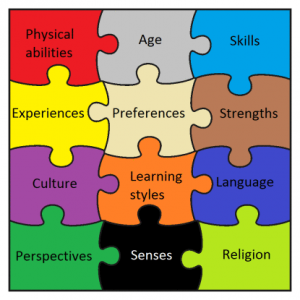 As stated in last week’s blog, Universal Design principles are intended to make a product, environment, or service accessible to all individuals – with a wide range of characteristics – by removing barriers proactively. The barriers can be in architectural design, as was the first area where Universal Design was applied, but also in education. The goal of Universal Design in education is to “…maximize the learning of students with a wide range of characteristics by applying UD principles to all aspects of instruction (e.g., delivery methods, physical spaces, information resources, technology, personal interactions, assessments).”
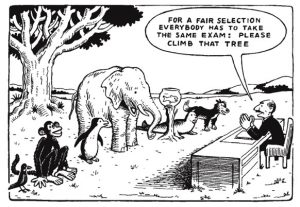

 Differentiated instruction requires a teacher to vary his or her approach to each student by customizing content, teaching techniques, learning strategies, and assessment tools. In order to do this, instructors need to identify the learning outcomes they want students to achieve, must understand how each student learns best, and then design differentiated instructional approaches and assessments. If they’ve tried something that doesn’t work, they go through the process again to adjust and adapt the learning experience for the student. Sounds like a lot of work? It is (not to mention adding classroom management and developing social skills into the mix) . . . thank your K-12 teachers!
 Since this is the beginning of the semester and professors are receiving Accommodation Memos from students, I thought this would be a good time to share some information about what is probably the most common accommodation: extended time on tests, quizzes, and in-class assignments. It also can be perceived by some as an “unfair advantage,” and this will be addressed as well.
 Over the past three weeks, I described some of the basic characteristics of Dyslexia, ADHD, and ASD, respectively. This week, I thought I would share some information about some of the other disabilities students have registered with at Student Accessibility Services.