
I will be co-facilitating some of the Camp Teach & Learn workshops next week. See below for details about these workshops. The two Wednesday afternoon workshops – Growth Mindset and Metacognition – will go into more depth about a blog topic from several weeks ago. Please come to learn more and participate!
Cultivating a “Growth Mindset” in Your Students
Wednesday 24 May 1 PM to 2:15 PM
One’s motivational mindset affects how much effort we expend and the expectations we have for ourselves. Carol Dweck, a researcher at Stanford University, has studied the impact of “fixed” vs. “growth” mindsets on learning. Those with fixed mindsets believe that their talents, abilities, and intelligence are fixed traits, that there is no way to change their allotment, and that these traits alone determine success. Alternately, people with growth mindsets believe that talents, abilities, and intelligence can be developed through dedication, effort, reflection, and revision; they view challenges and failures as opportunities to improve. A robust body of research suggests that students with growth mindsets are more persistent in the face of challenges and achieve at higher levels in the classroom than their fixed mindset peers. Come to this workshop to find out what mindset you hold, how that impacts your students’ learning experiences, and how to support the development of growth mindsets in your students. Please bring a laptop, tablet, or phone to participate in a brief mindset assessment.
Because growth mindset provides the foundation and buy-in to use metacognitive strategies, we recommend that you attend both this workshop and the following Metacognition workshop to maximize the benefits to your students.
Interactive workshop led by Loren Marulis, Jessica Naecker, and Melissa Shafner
Co-sponsored by Student Accessibility Services & Counseling Services
Helping Students Learn about Their Learning: Strategies for Cultivating Metacognition
Wednesday 24 May 2:30 PM to 4:00 PM
A basic definition of “metacognition” is thinking about your own thinking for the purpose of improving your learning. Think of it as having a Super Brain that directs your brain. Research has shown that metacognitive awareness of one’s own thinking and learning is a unique predictor of achieving learning outcomes. What we think of as “smart” is really the use of metacognition in coming up with effective strategies to successfully accomplish these learning goals. Some students use these strategies innately and intuitively, while others need to be taught what they are and how to use them. Come to this workshop to learn more about helping your students to plan, monitor, and evaluate their own thinking, as well as how you can be metacognitive about your own teaching.
It is highly recommended that you attend both this workshop and the Growth Mindset workshop as a growth mindset is what provides the foundation and buy-in to use metacognitive strategies.
Interactive workshop led by Jillian Marshall, Loren Marulis, and Melissa Shafner
The New Language Requirement: Advising, Accessibility, & Other Implications
Friday 26 May 1:30 PM to 3:00 PM
Sixty-nine percent of the class of 2020 engaged in language study in the 2016-17 academic year, a significant increase over past years that can clearly be attributed to the new Connections language requirement. Faculty and staff in various corners of campus have faced new challenges as a result of increased class sizes, the presence of students previously exempt from language study, and a noticeable shift in enrollment to the less commonly studied languages. How do we effectively advise students on their choice of language as they start their academic journey? What supports are needed to make language courses accessible to all students? This session, geared toward both advisers and foreign language faculty, will review and summarize enrollment data for the class of 2020, describe challenges, and invite listeners to discuss approaches moving forward.
Session led by Amy Dooling, Laura Little, Emily Morash, & Melissa Shafner
Co-sponsored by the Language and Culture Center, Office of the Dean of First-Year Students, and Student Accessibility Services

The SAS office wishes you a wonderful summer!!!
 The Student Accessibility Services office was buzzing this past year. We were busy with the usual registrations and accommodations, but I’d like to share some key achievements of which we are very proud:





 The time is almost upon us when students will be selecting classes for the fall semester. Choosing a course load that is “balanced” is important for all college students; for students with disabilities it can be of particular importance and the difference between success and . . . something else.
 Prior to my working at Connecticut College, I worked at another college in a program specifically for students with learning disabilities, ADHD, and Autism Spectrum Disorder. Most of these individuals had a track record of struggling to learn, and the goal for those of us who taught and advised the students was to teach these students how to learn so that they could be successful in college. In addition to using explicit instruction methods and incorporating a high level of executive function support and development, we incorporated how to use metacognition into our content classes.

 Having a growth mindset, the belief that the ability to learn can be increased and challenges overcome with effort, goes hand in hand with being metacognitive. After all, using metacognition focuses on the process being used, the journey to success, not just the end goal. A metacognitive approach shows that hard work does pay off. And with a growth mindset, one has the patience and resilience to work toward that payoff – what Carol Dweck, Stanford psychologist and growth mindset guru, describes as “the power of ‘yet’.” I can’t do it . . . yet.
 Last week we looked at factors that influence students’ motivation to learn. This week we’ll focus on two of those – motivation is increased when students perceive personal value in a learning goal and when they perceive a reasonable likelihood of being successful in achieving the goal. Much of this is applicable in the classroom context, but some suggestions may be even more appropriate to utilize in interactions with students that take place outside the classroom.
 All students are motivated. As educators, we hope it’s to be deeply involved in the learning process . . . but that’s not always the case. College students have competing interests that vie for their attention, time, and efforts. They have more access to independence, lack of supervision, and choice than they probably ever had before. Add in the constant presence of their peers and a range of opportunities for fun, and academics might not always make it to the top of the list.
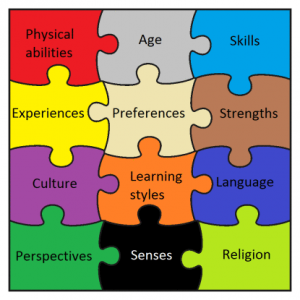 As stated in last week’s blog, Universal Design principles are intended to make a product, environment, or service accessible to all individuals – with a wide range of characteristics – by removing barriers proactively. The barriers can be in architectural design, as was the first area where Universal Design was applied, but also in education. The goal of Universal Design in education is to “…maximize the learning of students with a wide range of characteristics by applying UD principles to all aspects of instruction (e.g., delivery methods, physical spaces, information resources, technology, personal interactions, assessments).”


 Differentiated instruction requires a teacher to vary his or her approach to each student by customizing content, teaching techniques, learning strategies, and assessment tools. In order to do this, instructors need to identify the learning outcomes they want students to achieve, must understand how each student learns best, and then design differentiated instructional approaches and assessments. If they’ve tried something that doesn’t work, they go through the process again to adjust and adapt the learning experience for the student. Sounds like a lot of work? It is (not to mention adding classroom management and developing social skills into the mix) . . . thank your K-12 teachers!
