
Autism Spectrum Disorder (ASD) is a brain-based developmental disability that affects how information is processed; it specifically impacts communication and social interactions. Until recently, the autism spectrum included several distinct diagnoses, however since 2013 under the DSM-5 (Diagnostic and Statistical Manual, 5th edition), all of these diagnoses are now included under Autism Spectrum Disorder.
Symptoms of ASD range in severity. These symptoms can include difficulty with flexibility of thought and change in routine, obsessive interests, repetitive behaviors and routines, and sensory processing issues – both over-reactive and under-reactive. Most students with ASD who attend college fall under the diagnosis formerly referred to as Asperger’s Syndrome. You may still hear reference to Asperger’s since the DSM-5 specifically grandfathered this diagnosis for those who already had it. I also use the term “Asperger’s” below to describe individuals with ASD.
Individuals with Asperger’s have average to above-average intelligence, even at the gifted level. Asperger’s is technically not a learning or attention issue, however it can share a lot of similarities with both, and academic accommodations for all three are often similar. One symptom those with Asperger’s can share with individuals with ADHD includes difficulty with executive functioning – including organization, problem solving, and control over emotions. Also similar to those with ADHD, individuals with Asperger’s can be easily distracted by sensory input – sights, sounds, and smells. As with peers with language-based learning disabilities, people with Asperger’s can struggle to express themselves clearly and to follow auditory information. Similar to those with both ADHD and language-based learning disabilities, individuals with Asperger’s can also struggle with reading non-verbal cues, being overly literal, and not understanding jokes, puns, or idioms.
In the college setting, students with ASD can struggle both in and out of the classroom. In the classroom, an ASD student might have sensory difficulties with sounds that others can tune out and fluorescent lighting. They may also struggle with interacting with professors and classmates. When it comes to academic work, he or she can struggle with setting goals, planning, prioritizing, pacing readings and long-term assignments, comprehension of abstract ideas and analysis, and seeing the big picture not just details. Having a schedule that varies from day to day can also be difficult. Dorm life can be very difficult for ASD students for a variety of reasons – needing assistance with some daily living skills, needing a quiet space to get away from sensory overload, and difficulty in getting along with a roommate as they may struggle with understanding the thoughts and intentions of others or realizing how they come across to others.
ASD often co-exists with other conditions. An individual can have both ASD and ADHD. Some studies have shown that as many as half of individuals with ASD also have ADHD. Anxiety is also very common in individuals with ASD, perhaps occurring in as many as 85% of those with ASD. Depression is also more common among those with ASD than in the general population.
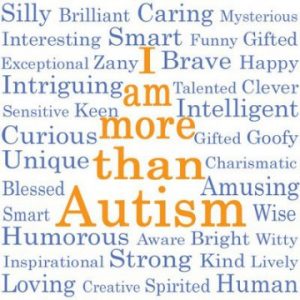
Neurodiversity, a concept that began within the autism field, provides a paradigm shift in how we think about mental functioning. Instead of looking at neurological differences as a deficit or dysfunction in mental processing, neurodiversity suggests we speak about differences in cognitive functioning (the same way we look at differences in biological or cultural diversity). The belief is that atypical neurological development is a normal human difference that is to be respected as any other human variation. Hardships are to be acknowledged, however we should also recognize an individual’s strengths.
Some of the strengths of those with Asperger’s include attention to detail, tendency to be logical, independent thinking, conscientiousness, and coming up with creative solutions. Their strengths often align well with careers in computer programming, engineering, video game design, accounting, statistics, physics, and math. Some famous people who have stated that they have Asperger’s include singer Susan Boyle, actress Daryl Hannah, actor Dan Aykroyd, and animal science professor Temple Grandin. Historians believe that Albert Einstein, Mozart, Michelangelo, Thomas Jefferson, Emily Dickinson, Lewis Carroll, and Nikola Tesla are some of the many famous individuals throughout history who met the criteria for Asperger’s.















 It’s not what you think. This is not about teaching and learning through playing World of Warcraft or Call of Duty. Rather, this model uses teaching strategies based on the design-concepts of video games and research on how the brain responds during video games. This week will introduce the concepts, and next week we’ll make the connection to applying this to the classroom.
