Metacognition and Growth Mindset

a frog thinking about a frog thinking about a frogPrior to my working at Connecticut College, I worked at another college in a program specifically for students with learning disabilities, ADHD, and Autism Spectrum Disorder.  Most of these individuals had a track record of struggling to learn, and the goal for those of us who taught and advised the students was to teach these students how to learn so that they could be successful in college.  In addition to using explicit instruction methods and incorporating a high level of executive function support and development, we incorporated how to use metacognition into our content classes.

Simply put, metacognition is thinking about your thinking for the purpose of improving your learning.  This second part is critical – it’s not merely a pondering, philosophical exercise (no offense to philosophers), but rather one with an explicit goal.  We think about our thinking to understand it better – its strengths and weaknesses – so that we can learn better.  We can teach students how to do that.  Equally important, educators can use it to evaluate and improve their teaching.

We think of our highest performing students as exceptionally smart, intelligent, bright.  The strength they really share is being metacognitive about their learning.  They may not know the term, or have ever consciously thought about what they are doing to be successful, but they are being metacognitive nonetheless.  It comes innately for some students – or at least they develop the ability fairly independently – while for many others, its development needs the guidance and support of others.
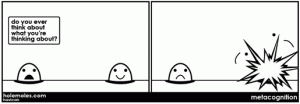
Cartoon character explodes thinking about his thinking

Let’s look at metacognition in a little more detail.  Metacognition involves constant monitoring of determining the task hand, the best way to approach it, how you’re doing, should you be doing something different.  Then reflecting on the entire process, and when necessary, cycling through again with any needed adjustments.  This requires understanding oneself as a learner, knowing options of strategies to use, determining which ones to use and when, evaluating whether they’re being effective or whether a different strategy is needed.  It’s being able to gauge when you understand something and when you don’t, and if it’s the latter, then being able to figure out what to do to aid comprehension.  It’s knowing when the process you’re using to monitor your learning is effective and being able to adapt your monitoring if it’s not.

Different analogies can be used with students to help explain this concept of metacognition.  For some, what is described in the paragraph above reminds them of seeing yourself in a mirror, looking at yourself in a reflection in a mirror, looking at yourself in a reflection in a mirror and so on.  Others describe it as “driving your brain” or “dissecting your learning.”  And one of my favorites, “doing therapy on your learning” – you can’t just take things as how they appear on the surface, but really break things down to see and understand what’s really going on, how are you helping or hurting yourself, what should you be doing differently.

Flower with quotation by Dweck "I haven't learned that ...yet."Having a growth mindset, the belief that the ability to learn can be increased and challenges overcome with effort, goes hand in hand with being metacognitive.  After all, using metacognition focuses on the process being used, the journey to success, not just the end goal.  A metacognitive approach shows that hard work does pay off.  And with a growth mindset, one has the patience and resilience to work toward that payoff – what Carol Dweck, Stanford psychologist and growth mindset guru, describes as “the power of ‘yet’.”  I can’t do it . . . yet.

During Camp Teach & Learn at the end of May, there will be a workshop on using metacognition to teach and teaching metacognition as well as a workshop on developing a growth mindset in your students.



Increasing Motivation to Learn: Establishing Value and Building Positive Expectancies

toddler trying to push a carLast week we looked at factors that influence students’ motivation to learn.  This week we’ll focus on two of those – motivation is increased when students perceive personal value in a learning goal and when they perceive a reasonable likelihood of being successful in achieving the goal.  Much of this is applicable in the classroom context, but some suggestions may be even more appropriate to utilize in interactions with students that take place outside the classroom.
Strategies to Establish Value

A significant step toward increasing a student’s perception of the value of a learning goal is to connect material to the student’s interests.  Allowing flexibility when possible for students to choose topics or projects helps them to see and feel (to connect with) the personal value in an assignment.  Another essential piece is to help show the student how this current goal is connected to their larger academic and professional goals.  What is the student’s major?  What do they want to do after school in their professional lives?  Even if they don’t know, how do the skills they will develop through an assignment or course connect more broadly to transferable professional skills?  Value in the small pieces can be increased when students see how they fit into their bigger vision.

This relates to another strategy to increase perception of value:  provide authentic, real-world tasks when possible.  This helps to connect abstract theory to something more tangible.  When students produce work to share with others, this is a move in this direction.  Depending on the class, this could mean assignments or projects that involve writing that will be published, posters that will be presented, pieces that will be performed, designed-objects that will be used by others, etc.

Finally, remember that an important way to establish value is to show students your own enthusiasm for the field of study you’re in and to explain what you value about it and why.

Strategies to Build Positive Expectancies

Students come to us carrying the experiences of their past.  Therefore, whether they feel they will be successful on an assignment or in our class, is the result of how they have performed in school throughout their education.  For some the past has provided confidence in their own abilities, and for others, it has created doubt.  What can we do now to help increase students’ expectation of success?

One way to help is to gauge what your students already know about something or can already do, and then see how this compares to your learning objectives for the class.  Do you need to provide more of a foundation than you expected?  Are you setting reasonable levels of challenge for them?  If students are not where they need to be, how will you scaffold them in order to help them get there?  Students will be motivated by achievable challenges – challenges that require effort, but are attainable.  Providing the right level of challenge at the right time is key as well. Starting off a course with smaller, low-stakes assignments can allow early opportunities for success, which can go a long way in building confidence and expectation of success as work becomes more challenging.

Making your expectations clear and providing assistance in how to meet those expectations is essential.  Explain to students what you expect them to do, how they can achieve those goals, what difficulties they might encounter, ways for them to overcome these difficulties, and what support you and others at the college offer.   Provide students with rubrics and frequent opportunities to get feedback from you.  Feedback should be timely so that students can use it on the next iteration of an assignment.  Point out strengths as well as areas that need improvement.  Make suggestions for how students can work toward improvement.  Explain to students not only what to study, but how to study to prepare for your tests or quizzes.

Equally, if not more, essential to creating an expectation of success in students is how you frame successes and failures in your interactions with them in and out of the classroom.  Also critical is teaching students how to reflect on their own learning for the purpose of improving it.  After spring break, we’ll look at a growth vs. fixed mindset and well as teaching students to learn with metacognition.  You can kick off this topic by attending the Talking Teaching workshop “Fostering Student Metacognition” tomorrow, Wednesday March 8 from 3-4:30pm in Hood!


Applying Principles of Universal Design in the Classroom

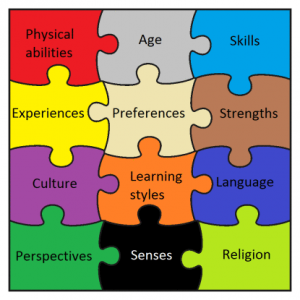
UD PuzzleAs stated in last week’s blog, Universal Design principles are intended to make a product, environment, or service accessible to all individuals – with a wide range of characteristics – by removing barriers proactively.  The barriers can be in architectural design, as was the first area where Universal Design was applied, but also in education.  The goal of Universal Design in education is to “…maximize the learning of students with a wide range of characteristics by applying UD principles to all aspects of instruction (e.g., delivery methods, physical spaces, information resources, technology, personal interactions, assessments).”[i]

The original Universal Design architectural principles, each followed by an example of how to apply these principles in education, are:

  1. Equitable use. The design is useful to people with diverse abilities. Example: A professor’s website is designed so that it is accessible to everyone, including students who are blind and use text-to-speech software.
  2. Flexibility in use. The design accommodates a wide range of individual preferences and abilities. Example: A museum, visited as a field trip for a course, allows each student to choose to read or listen to a description of the displays.
  3. Simple and intuitive use. Use of the design is easy to understand, regardless of the user’s experience, knowledge, language skills, or current concentration level. Example: Control buttons on science equipment are labeled with text and symbols that are simple and intuitive to understand.
  4. Perceptible information. The design communicates necessary information effectively to the user, regardless of ambient conditions or the user’s sensory abilities. Example: A video shown during class includes captions.
  5. Tolerance for error. The design minimizes hazards and the adverse consequences of accidental or unintended actions. Example: Educational software provides guidance and background information when the student makes an inappropriate response.
  6. Low physical effort. The design can be used efficiently, comfortably, and with a minimum of fatigue. Example: Doors to a lecture hall open automatically for people with a wide variety of physical characteristics.
  7. Size and space for approach and use. Appropriate size and space is provided for approach, reach, manipulation, and use regardless of the user’s body size, posture, or mobility. Example: A flexible science lab work area has adequate workspace for students who are left- or right-handed and for those who need to work from a standing or seated position.[ii]

Two additional principles added specifically regarding education are:

  1. A community of learners. The instructional environment promotes interaction and communication among students and between students and faculty.
  2. Instructional climate. Instruction is designed to be welcoming and inclusive. High expectations are espoused for all students.[iii]

Faculty can implement these principles in teaching strategies they use, the instructional materials they require or provide, classroom setup and facilities, and activities and field trips.  This is intended to benefit not just students with disabilities, but students with varying learning styles, language skills, backgrounds, interests, and levels of motivation, among other differences.


Some suggestions for faculty on applying Universal Design to their teaching:

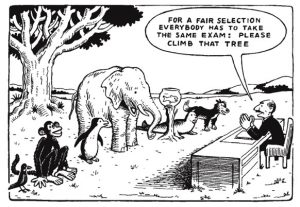
Cartoon showing variety of animals who must climb a tree as a test

  • Include a statement in your syllabus inviting students to talk with you and/or Student Accessibility Services about disability-related issues.
  • Point out campus resources available to all students such as the Academic Resource Center, Tutoring Center, Writing Center, and Counseling and Health Centers.
  • Clearly and early in a course, define course requirements, announce the dates of exams, and tell students when assignments are due. Avoid last-minute readings or additional assignments and provide advance notice of changes in assignments and due dates.
  • Provide printed materials early to allow students sufficient time to read and comprehend the material. Many students with learning disabilities use software that can read the textbook and other text-based materials aloud. In order for them to take advantage of this technology, the printed text must first be converted into an electronic file; this process can be time-consuming.
  • Use multi-modal methods to present classroom material in order to address a variety of learning styles and strengths (e.g., auditory, visual, kinesthetic). Provide important information in both oral and written formats.
  • When teaching a lesson, state objectives, review previous lessons, and summarize periodically. Repeat important information several times.
  • Use more than one way to demonstrate or explain information. Draw pictures, charts, or use other visual representations when possible.
  • Read aloud what you write on the board or present an overhead visual. Allow time to copy before erasing and/or allow students to take a picture with their phones.
  • Keep instructions brief and uncomplicated. Repeat them word-for-word.
  • Allow time for clarification of directions and essential information.
  • Use captioned videos and know how to turn on the captioning feature. Although captioned videos are typically used for students who are hearing impaired, they also help some students with learning disabilities and those for whom English is a second language by ensuring content is presented visually and audibly. Give all students an opportunity to view a video multiple times (e.g., by making it available in a library or on Moodle).
  • Provide study guides or review sheets.
  • Have multiple methods for assessment, such as allowing students to take an exam or write a paper; work alone or in a group; or deliver an oral, written, or videotaped project presentation.
  • Stress organization and ideas rather than mechanics when grading in-class writing assignments and assessments.[iv]

Endnotes:

[i] Sheryl Burgstahler, “Universal Design of Instruction (UDI):  Definition, Principles, Guidelines, and Examples,” DO-IT (Disabilities, Opportunities, Internetworking, and Technology) University of Washington, Accessed Feb. 16, 2017, http://www.washington.edu/doit/universal-design-instruction-udi-definition-principles-guidelines-and-examples .

[ii] Ibid.

[iii] “Nine Principles of UDI,” University of Connecticut Neag School of Education Center on Postsecondary Education and Disability/Center for Students with Disabilities, Accessed Feb. 19, 2017, http://udi.uconn.edu/index.php?q=node/12 .

[iv] Adapted from “Academic Accommodations for Students with Learning Disabilities,” DO-IT (Disabilities, Opportunities, Internetworking, and Technology) University of Washington, Accessed Feb. 19, 2017, http://www.washington.edu/doit/sites/default/files/atoms/files/Academic-Accommodations-Learning-Disabilities.pdf .

Looking to K-12 to Help Develop “Full Participation” in the Classroom

closeup of colorful crayon tips

There has been focus and discussion here at Conn regarding “full participation” in all aspects of the College, including in the classroom.  The working definition of full participation we are using is from Susan Sturm:

Full participation is an affirmative value focused on creating institutions that enable people, whatever their identity, background, or institutional position, to thrive, realize their capabilities, engage meaningfully in institutional life, and contribute to the flourishing of others.   http://wordpress.conncoll.edu/connections/full-participation/

Interestingly, this is very similar language used by educators who focus their work on teaching students with learning disabilities.

In fact, students today come to college very familiar with this notion of full participation because this concept has been applied in K-12 classrooms since before they were born.  Today’s K-12 teachers are expected to reach and teach all of their students, with most special education occurring in the classroom as well.  The range is huge – students with intellectual impairments, students with learning disabilities, students who are underprepared, English Language Learners, typical learners, gifted learners, etc.  The way that K-12 teachers do this is through what is called “differentiation.”   This essentially entails determining where a student is academically and then how to support each and every student – bringing those who need remediation up to speed and challenging and pushing those who are advanced beyond grade level, and everything in between.

DifferentiationDifferentiated instruction requires a teacher to vary his or her approach to each student by customizing content, teaching techniques, learning strategies, and assessment tools.  In order to do this, instructors need to identify the learning outcomes they want students to achieve, must understand how each student learns best, and then design differentiated instructional approaches and assessments.  If they’ve tried something that doesn’t work, they go through the process again to adjust and adapt the learning experience for the student.  Sounds like a lot of work?  It is (not to mention adding classroom management and developing social skills into the mix) . . . thank your K-12 teachers!

We can use some of these same approaches that have been applied during students’ K-12 years to teaching students in college.  A significant step in this direction that has gotten attention at Conn is in applying principles of universal design for learning (also referred to as universal design for instruction).  Universal design for learning is a framework based on the philosophy of inclusion – making learning accessible to all students, addressing diverse needs, interests, and abilities.  Universal design for learning provides for different methods for students to take in information and to demonstrate what they know.  The approach increases student motivation, which contributes significantly to improved learning.

Universal design originated in architectural design, making physical space accessible to all, both those with and without disabilities.  In the same vein, universal design applied to learning is meant to benefit all students, with and without disabilities.  In addition to this benefit for all, a particular benefit for students with disabilities is that it can greatly reduce their need to ask for accommodations when access is given to all from the outset.

Next week we will focus on some specific examples of applying universal design for instruction and learning in the classroom.


The Accommodation of Access to Notes & How Faculty Can Make Notes More Accessible

pen resting on pad of paperA student with the accommodation of “access to notes” might have qualified for the accommodation due to a visual or hearing impairment, an attentional issue, a processing difficulty, or a struggle with working memory.  There are different ways of providing this access depending upon the individual’s functional limitations, therefore an Accommodation Memo might list “use of a recording device” or “access to a peer note taker.”  There are also variations that include “copy of teacher notes” or “copy of PowerPoint slides in advance.”

The reason for the note taking assistance is that something about the individual’s disability impacts his or her ability to create a set of notes that documents important information from class.  The level of impact varies, and the accommodation should be in line with the extent that the individual’s note-taking capacity is limited.  Student Accessibility Services is working toward customizing this, looking at each student’s ability to take notes and what he or she needs to be able to create notes at the same level as students without disabilities.

For example, many students with disabilities take notes in class, however due to a slower processing speed or attentional issues, may miss some information during the lecture or discussion.  For these students, the accommodation of “use of a recording device” is ideal because the recording allows the student to go back later and fill in the missing information.  There are technology devices – referred to as assistive technology – that can make this very easy and efficient for students.  Assistive technology refers to a device or program that allows those with disabilities to enhance their functionality and increase their independence.

Two pieces of assistive technology for note taking, which are available for students to borrow from the SAS office, are the Livescribe Smart Pen and Sonocent Audio Notetaker program.  The Smart Pen is used in conjunction with a special notebook that includes markings on it to start and stop the pen’s recording; there are also markings on the page that align the recording with where your written notes are on the page.  So, a student touches the spot on the page where she missed something in the notes, and she can listen back and fill in her notes.  Or, a student can just listen back to a part of the lecture that was unclear or challenging.

Sonocent Audio Notetaker works in a similar way, but is a computer program.  The lecture is recorded through the student’s laptop, and the student’s typed notes are aligned with the recording.  If something is missed in the notes – just click in that spot and that part of the lecture is replayed.  There are also tablet and smartphone apps that perform similar tasks.

For many students with disabilities, the use of assistive technology enables them to take their own notes, with the technology able to compensate for their functional limitations.  The benefit is that students are able to make a complete set of notes independently and do not have to rely upon another student’s judgment as to what was important enough to include in notes.  Also, another student may already know or understand something and therefore not include that in their notes.  Taking your own notes with technology assistance avoids these issues.

The accommodation of a peer note taker is intended for a student who cannot make a set of usable notes independently that can then be supplemented with the use of assistive technology.  The peer note taker is still intended to supplement the student’s own notes to the extent that the student can take his or her own notes independently.

There are some ways that faculty can proactively make class notes more accessible for all students (following principles of universal design for instruction).  One is by putting your own notes (or a skeletal outline for students to fill in) onto Moodle, so that all students in class can use those to compare to their own notes – students will fill in their own notes or rely on the teacher’s notes as needed.  students in classroom taking picture of boardThis can be especially helpful in classes with mathematical problems where it may be hard for students to accurately or quickly copy what the teacher is writing on the board, and a recording of such may not be very useful when the primary intake is visual.  A second is to have a dedicated class note taker (class members can take turns) who posts his or her notes on Moodle for the rest of the class to review and compare to their own notes.  A third is to record the class – audio or video – and post the recording on Moodle.  And finally, a simple method is to allow students to take a picture of the board with their phones if you’ve written a lot of information, drawn a diagram or chart, or solved a math problem that may be hard to recreate in their notes.
Faculty and staff members who are interested in learning more about assistive technology can contact Lillian Liebenthal at x5428.


Concerns About Recordings

No photography, no recording signSome faculty members worry that recordings stifle class discussions or may be misused.  First and foremost, §504 of the Rehabilitation Act of 1973 doesn’t mention many specific accommodations, but it does explicitly state “use of tape recorder” as an example of providing access when necessary for an individual with a disability.  So, like it not, it’s one of the few things that the law explicitly includes.  Secondly, if there is a sensitive topic being discussed, students who are recording can be told to stop – as long as students taking written notes are told not to take notes at that time (remember, it’s about equal access, so if no students can take notes, then students with a note taking accommodation don’t get to either).  Thirdly, our Use of Recording Device policy and agreement address appropriate use of recordings – click on the links to read the limitations of the use of the recordings and consequences for misuse of recordings.

Video Game Model of Learning (part 2)

photo of man running up stairs with message "I may not be there yet but I'm closer than I was yesterday"

We can apply the principles used in video game design to classroom practices.  The same dopamine-reward response that drives one to not just play video games – but persevere in the quest to improve – can also motivate a student in academics.  This is based on the research of Judy Willis, M.D., a neurologist and educator, who is an authority on the neuroscience of learning and how that can be incorporated into best teaching practices.  Her work has been of particular interest to educators who work with students with learning differences, as these students often struggle with motivation regarding academics.

Remember from last week that a larger than usual amount of dopamine (enough to make it feel good) is released when the brain recognizes that it just made a successful prediction or behavioral response.  This dopamine surge requires some uncertainty about success – there must be a challenge that has not already been mastered.

Achievable Challenge Level

Video games are designed to get you to your achievable challenge level very quickly so that you will not be bored with a level that is too easy, nor frustrated by one that is too difficult.  In education, we call this is the zone of proximal development – it’s where you are challenged at just the right level that you maintain motivation and will persevere to learn.  Ideally, academic learning experiences are individualized for each student at his or her level of achievable challenge.   Yes, the teaching and task need to be appealing to the student, but the “just right” level of challenge is what will cause the student to expend the effort to work through a challenge.  The brain will also be more responsive to feedback under these circumstances – it knows that the dopamine surge is within reach . . . and it wants it.  This results in increased student engagement.

Incremental Goal Progress and Frequent Feedback

Video games do not require mastery all at once with the reward delayed until mastery is achieved. They allow the player to build the skills gradually and receive frequent rewards; the dopamine reward occurs each time the player receives feedback that a correct response was made.  When the big dopamine surge comes at the successful completion of a level, that is what motivates the player to work harder at the next level, which is a bigger challenge.  Remember, you must move on to more challenge to receive more dopamine.  Also remember from last week, that when you hit an 80% failure rate, the games are designed to give you some type of guiding feedback to assist in the incremental progress.

Teachers can use this same principle of making students aware of incremental progress toward a goal.  This can be done by setting smaller goals that build to an end goal, while also providing frequent feedback to students on their successes and guidance when they are off-track to help bring about some reward/reinforcement that progress is being made.  Remember, they need to know they have made progress in order for the dopamine-reward to occur.  Delayed gratification is not a strong-suit of the adolescent brain – show your students the progress they are making, even if it is incremental.  It is particularly beneficial in sustaining motivation and effort if the teacher can show the students how to recognize incremental progress on their own.

Mistakes as a Necessary Part of Mastery

Video game players are perfectly fine with an 80% failure rate!  It is accepted as a necessary part of mastering the challenge.  While I’m not sure that we’d ever get students to feel comfortable with that percentage in the classroom, we can strive to instill in our students a growth mindset (a topic for future discussion) – the belief that mistakes are a normal and necessary part of the learning process and are necessary for growth.  The growth mindset promotes the ideas that you can “grow your brain” and “the power of ‘yet’” – you will get there, but you are not there yet.  It sounds simple, but convincing students who are struggling that they will master something, but just aren’t there yet, is powerful and has been shown to be highly effective in promoting learning.

Video Game Model of Learning (part 1)

boy's hands holding video game controllerIt’s not what you think.  This is not about teaching and learning through playing World of Warcraft or Call of Duty.  Rather, this model uses teaching strategies based on the design-concepts of video games and research on how the brain responds during video games.  This week will introduce the concepts, and next week we’ll make the connection to applying this to the classroom.

Video games are motivating!  The driving force behind this is dopamine, a neurotransmitter that produces feelings of great pleasure when more than the usual amount is released.  When the brain makes a successful prediction or behavioral response, this triggers a feel-good release of dopamine, which causes the brain to want to repeat the action.  The key is that there must be some challenge or risk – a chance of being unsuccessful – in order for this dopamine reward to take place.  Doing something that is a “sure thing” or unchallenging does not bring about this chemical reward.

Video games are a series of opportunities to make predictions and choices that the player acts upon.  Players receive frequent feedback as to how they’re doing – points, sounds, tokens, etc. They are immediately aware of their successes.  With each success, there are repeated hits of dopamine with an even larger surge when a player has successfully completed a level and gets to move on to the next one.  The brain pushes the player to continue in the hopes of further challenges and more hits of dopamine.  The neural pathways in the brain that brought about that success and dopamine response are reinforced, becoming stronger and more durable.

What’s the right level of challenge for a player?  There needs to be an actual challenge in order to get the dopamine reward, but it also can’t be so difficult that the expectation of success is slim.  Think of it as the “Goldilocks challenge” – just right.  The results of fMRI studies show that the brain evaluates the likelihood of success of a cognitive task before expending the effort to attempt to solve the task.  Only when the brain perceives that there is a reasonable chance at success, will the dopamine response be activated.

Video games have levels that the player must progress through.  A player will move quickly through the levels at which he’s already skilled.  Once the player reaches the “just right” level, the fun begins.  Players make errors (unsuccessful predictions or actions) 80% of the time (in fact the games are designed this way), however players are given just enough hints or some other type of feedback to help maintain the expectation of possible success and therefore sustain interest in continuing to play.  Once a level is mastered, the player must be challenged with more difficult tasks because once a skill is achieved, there will be no dopamine reward for successful completion of that skill.  Therefore, increased challenges (i.e., the next level of the game) are sought out in order to maintain this reward.

The adolescent brain needs more frequent dopamine hits than the adult brain (the prefrontal cortex is not fully developed until age 25-30) in order to stay motivated through challenges.  It makes sense then that the design of video games can be an excellent model for addressing other types of challenges as well.  Next week, we’ll look at how these concepts can be transferred from the video game model to teaching applications.


Explicit Instruction

photo of hamburger with a variety of toppingsDifficulties associated with learning disabilities can include trouble distinguishing the big picture from supporting details, as well as understanding abstract concepts.
College classes often involve a significant amount of implicit instruction, where information or problems are presented to students to explore, assimilate, comprehend, and determine how it fits with existing knowledge on their own.  Explicit instruction (or direct instruction), on the other hand, clearly outlines learning goals for students and directly explains skills or concepts, as well as how they relate to other skills or concepts.

For LD students, explicit instruction strategies can often be very beneficial, even at the college level. The instructor directly explains a skill or concept, then models that same skill/concept, often using a “think aloud” to demonstrate the method or thought processes involved.  The instructor provides guided practice for the students, with immediate feedback to the student.  Moving forward the instructor scaffolds the student’s practice less and less, building toward independence.

Here’s an example of this approach that I’ve used.  I had my students read a chapter of a non-fiction book (Malcolm Gladwell’s Outliers) and then asked them the main idea of the chapter.  A student answered that the majority of professional hockey players have birthdays in January, February, or March.  The rest of the class agreed.  I told them hockey players had nothing to do with the main idea of the chapter, that hockey players were a “pickle.”  Yes, I got odd looks…but, they were intrigued.

I then asked the class what they would need if they wanted to make themselves an excellent burger.  Some kind of patty, right?  Beef, turkey, veggie, whatever, but without a patty, you just don’t have a burger.  It is the main point of the burger.  I took out my colored marker set and drew a brown patty on the whiteboard.  I asked what else you need for a burger.  Some kind of bread – bun, roll, focaccia, etc.  It’s essential to support the patty otherwise you have a mess on your hands, literally.  The bun represents the key points that are necessary to support your main idea.  I drew a yellow bun around the patty.  What makes the burger exciting to eat?  All the stuff you put on the burger – mustard, ketchup, mayo, cheese, onions, lettuce, bacon, avocado, pickles . . . !  Those are the details of the burger that help make it delicious; they enhance the burger the same way an author uses interesting details to help support and explain the main idea. I used all the other colors to draw on a bunch of toppings.  Since distinguishing the big picture from details can be a struggle for LD students, the drawing was a concrete representation of those abstract concepts.

Do hockey players as pickles make sense now?  The story about the discovery that the majority of hockey players have birthdays in January, February, or March was a (deceptive) detail in the chapter.  Deceptive because it sure takes up a lot of pages in the chapter.  But, that doesn’t necessarily mean it is the main idea, and the students needed to be told that outright.

How did I then guide them to figure out the main idea? Explicit instruction in how to read the text.  The chapter is divided into six sections – why?  Does each section have a purpose or key point?  I walked the class through certain key paragraphs.  What is the significance of this word or phrase?  Which sentence in this paragraph should jump out at you?  How does this paragraph function in the context of the chapter?  I didn’t give them the answers outright, but guided them through the types of things to look for when reading a non-fiction text.

I also used explicit instruction regarding the relationship of ideas – how the interesting details that they focused on support the key points, which in turn support the main idea.  I supplemented that discussion with another visual representation – I drew an umbrella shape, writing the main point on the umbrella top in one color, with details in a different color contained underneath the umbrella to represent their relationship to each other.  This type of visual cue can be very helpful for LD learners as it helps to ground their thinking.

Even if much of a class involves implicit instruction, incorporating explicit instruction at times can be beneficial to all students.  It can be especially helpful to consider this approach in a one-on-one context with a struggling student.


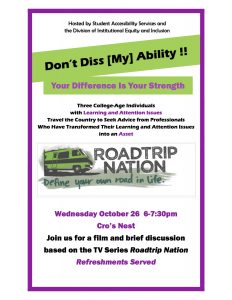
Reminder:  Upcoming Film Event ! ! !

poster for SAS film event 10/26/16 at 6pm in Cro's Nest


Wait Time

A clock with the word "waiting" on the faceWait time is the window between a teacher’s asking a question and expecting a student to respond.  What usually happens when a student doesn’t respond quickly?  The teacher either expands upon the question, provides an answer, or cold calls on someone else.  Teachers typically wait only up to one second after asking a question before moving on to one of these options.  When students do respond that quickly after the question, the answer tends to be a superficial response.
Research has shown that increasing  wait time from 1 second to 3-5 seconds can have significant benefits including increases in response length and quality, the number of volunteer responses, student confidence, the number of student follow up questions, and the amount of student interaction with each other.

Remember from last week that the neurological differences that cause learning disabilities affect a person’s ability to receive, store, process, retrieve or communicate information.  Taking in information, processing it, and forming a response often take longer in an LD student.  This is why we have the accommodation of extended time during tests.  This is also why an LD student likely needs a longer wait time when asked a question.  It allows the student’s brain to take in and process the question and formulate their response.  It also helps to decrease the stress that builds up in the LD student who is working on an answer, but at the same time knows that the teacher is expecting a quick response; stress slows down processing even more, which only exacerbates the situation for this student.  An LD student who feels the pressure of needing to respond quickly, will often resort to “I don’t know,” not because they don’t know, but because they have learned that they can’t get an answer out fast enough so why try.

There is actually a second wait time – the time between the student’s response and the teacher’s reaction.  Again, research shows that teachers typically wait less than one second before reacting to a student’s response.  Increasing this wait time to 3-5 seconds allows the student to expand upon their answer, which allows the student to use higher order thinking.  This also leads to better class discussions.

Photo of Claude Debussy with quotation "Music is the silence between the notes."

This sounds simple and can make a big difference in student achievement.  The tricky part is that teachers aren’t comfortable with silence – we think the student doesn’t have an answer or that learning isn’t taking place if there is silence.  One suggestion is to put it right out there to students that after you ask a question, you want “thinking time” before you will call on anyone or before anyone raises a hand.  Allowing longer wait time can also concern teachers who feel as if they have a large amount of material to get through and by increasing wait time, they will not get through as much.  However, research has shown that increased wait time results in better understanding, therefore less time is spent on follow up questions and clarification – it can actually make class time more efficient and effective.