
Explicit Instruction

photo of hamburger with a variety of toppingsDifficulties associated with learning disabilities can include trouble distinguishing the big picture from supporting details, as well as understanding abstract concepts.

College classes often involve a significant amount of implicit instruction, where information or problems are presented to students to explore, assimilate, comprehend, and determine how it fits with existing knowledge on their own.  Explicit instruction (or direct instruction), on the other hand, clearly outlines learning goals for students and directly explains skills or concepts, as well as how they relate to other skills or concepts.

For LD students, explicit instruction strategies can often be very beneficial, even at the college level. The instructor directly explains a skill or concept, then models that same skill/concept, often using a “think aloud” to demonstrate the method or thought processes involved.  The instructor provides guided practice for the students, with immediate feedback to the student.  Moving forward the instructor scaffolds the student’s practice less and less, building toward independence.

Here’s an example of this approach that I’ve used.  I had my students read a chapter of a non-fiction book (Malcolm Gladwell’s Outliers) and then asked them the main idea of the chapter.  A student answered that the majority of professional hockey players have birthdays in January, February, or March.  The rest of the class agreed.  I told them hockey players had nothing to do with the main idea of the chapter, that hockey players were a “pickle.”  Yes, I got odd looks…but, they were intrigued.

I then asked the class what they would need if they wanted to make themselves an excellent burger.  Some kind of patty, right?  Beef, turkey, veggie, whatever, but without a patty, you just don’t have a burger.  It is the main point of the burger.  I took out my colored marker set and drew a brown patty on the whiteboard.  I asked what else you need for a burger.  Some kind of bread – bun, roll, focaccia, etc.  It’s essential to support the patty otherwise you have a mess on your hands, literally.  The bun represents the key points that are necessary to support your main idea.  I drew a yellow bun around the patty.  What makes the burger exciting to eat?  All the stuff you put on the burger – mustard, ketchup, mayo, cheese, onions, lettuce, bacon, avocado, pickles . . . !  Those are the details of the burger that help make it delicious; they enhance the burger the same way an author uses interesting details to help support and explain the main idea. I used all the other colors to draw on a bunch of toppings.  Since distinguishing the big picture from details can be a struggle for LD students, the drawing was a concrete representation of those abstract concepts.

Do hockey players as pickles make sense now?  The story about the discovery that the majority of hockey players have birthdays in January, February, or March was a (deceptive) detail in the chapter.  Deceptive because it sure takes up a lot of pages in the chapter.  But, that doesn’t necessarily mean it is the main idea, and the students needed to be told that outright.

How did I then guide them to figure out the main idea? Explicit instruction in how to read the text.  The chapter is divided into six sections – why?  Does each section have a purpose or key point?  I walked the class through certain key paragraphs.  What is the significance of this word or phrase?  Which sentence in this paragraph should jump out at you?  How does this paragraph function in the context of the chapter?  I didn’t give them the answers outright, but guided them through the types of things to look for when reading a non-fiction text.

I also used explicit instruction regarding the relationship of ideas – how the interesting details that they focused on support the key points, which in turn support the main idea.  I supplemented that discussion with another visual representation – I drew an umbrella shape, writing the main point on the umbrella top in one color, with details in a different color contained underneath the umbrella to represent their relationship to each other.  This type of visual cue can be very helpful for LD learners as it helps to ground their thinking.

Even if much of a class involves implicit instruction, incorporating explicit instruction at times can be beneficial to all students.  It can be especially helpful to consider this approach in a one-on-one context with a struggling student.


Reminder:  Upcoming Film Event ! ! !
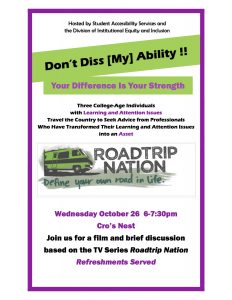
poster for SAS film event 10/26/16 at 6pm in Cro's Nest


Wait Time

A clock with the word "waiting" on the faceWait time is the window between a teacher’s asking a question and expecting a student to respond.  What usually happens when a student doesn’t respond quickly?  The teacher either expands upon the question, provides an answer, or cold calls on someone else.  Teachers typically wait only up to one second after asking a question before moving on to one of these options.  When students do respond that quickly after the question, the answer tends to be a superficial response.


Research has shown that increasing  wait time from 1 second to 3-5 seconds can have significant benefits including increases in response length and quality, the number of volunteer responses, student confidence, the number of student follow up questions, and the amount of student interaction with each other.

Remember from last week that the neurological differences that cause learning disabilities affect a person’s ability to receive, store, process, retrieve or communicate information.  Taking in information, processing it, and forming a response often take longer in an LD student.  This is why we have the accommodation of extended time during tests.  This is also why an LD student likely needs a longer wait time when asked a question.  It allows the student’s brain to take in and process the question and formulate their response.  It also helps to decrease the stress that builds up in the LD student who is working on an answer, but at the same time knows that the teacher is expecting a quick response; stress slows down processing even more, which only exacerbates the situation for this student.  An LD student who feels the pressure of needing to respond quickly, will often resort to “I don’t know,” not because they don’t know, but because they have learned that they can’t get an answer out fast enough so why try.

There is actually a second wait time – the time between the student’s response and the teacher’s reaction.  Again, research shows that teachers typically wait less than one second before reacting to a student’s response.  Increasing this wait time to 3-5 seconds allows the student to expand upon their answer, which allows the student to use higher order thinking.  This also leads to better class discussions.

Photo of Claude Debussy with quotation "Music is the silence between the notes."

This sounds simple and can make a big difference in student achievement.  The tricky part is that teachers aren’t comfortable with silence – we think the student doesn’t have an answer or that learning isn’t taking place if there is silence.  One suggestion is to put it right out there to students that after you ask a question, you want “thinking time” before you will call on anyone or before anyone raises a hand.  Allowing longer wait time can also concern teachers who feel as if they have a large amount of material to get through and by increasing wait time, they will not get through as much.  However, research has shown that increased wait time results in better understanding, therefore less time is spent on follow up questions and clarification – it can actually make class time more efficient and effective.


A Brief Introduction to Learning Disabilities

side image of human head with brain and its wiring lit up in neonWe’re shifting from discussing accommodations to tips and strategies for helping students with learning disabilities in the classroom (in fact, they can benefit students without disabilities as well).

It is necessary to know the basic definition of a learning disability in order to understand why these strategies help.  Learning disabilities are learning problems that are not primarily related to intellectual disability or emotional disturbance. These problems are caused by neurological differences in brain structure and function that affect a person’s ability to receive, store, process, retrieve or communicate information.  It is often assumed that learning disability means below average IQ, however this is not the case – by definition, in order to have a learning disability one must have average to above average intelligence.

There are many types of learning disabilities (in the future we can get more specific), but for now we won’t distinguish since these recommendations can benefit all students whether they have what typically falls under Learning Disability (LD), Attention-Deficit/Hyperactivity Disorder (ADHD), or Autism Spectrum Disorder (ASD) (which now includes what was formerly called Asperger’s).   It is important to realize that the comorbidity rate of having an anxiety disorder in addition to any of these above-mentioned disabilities is as high as 50%.  Anxiety also impacts learning.

There are a few more things that are helpful to understand about students with learning disabilities.  First, many students with learning disabilities suffer from low self-esteem and set low expectations for themselves with greater frequency than their non-LD peers.  Second, the difference between high school and college expectations is often cited as a major challenge by LD students, so helping bridge this gap is important.  Confusion and feeling overwhelmed can often result in escape behavior, which is why students who struggle often don’t seek help.  This is compounded by the feeling of not wanting to be different from their peers, as well as by learned helplessness from having received too much support in the past.  Finally, LD students need to be honest with themselves about the fact that they may need to work harder than their peers in order to do well.

It is important for faculty and staff to understand ways that we can support LD students because research tells us that LD students who successfully complete college overwhelmingly attribute having developed a significant relationship with someone in the disability services office or a faculty member as a significant key to their success.  Research also stresses that the strength of the disability services office and level/quality of communication, coordination, and collaboration with the rest of campus is key to the success of LD students.

Next week we start with these strategies by discussing “Wait Time.”


Upcoming Film Event ! ! !

Please consider attending — and please inform students — about this event.

SAS Film event poster FINAL

The Accommodation of Flexibility in Assignment Deadlines

an exaggerated blown up face of a man pointing at a clockLast week we looked at flexibility in attendance.  This week, we’ll apply the same analysis to flexibility in assignment deadlines.
Again, we start with determining whether there is an access issue.  We often give extended time during tests due to the functional limitations of a disability.  Why not the same for longer assignments outside of class time?  The answer is that tests are given during a relatively short, fixed block of time where it is expected that non-disabled students will use that entire amount of time.  Hence in order to provide access, we accommodate students with disabilities through extended time.  Longer term assignments are not expected to be done during every minute of the student’s non-class time – students plan and manage their assignments in order to complete them on time and the expectation is that there is sufficient time for students, including students with disabilities, to get that work done by the deadline.  Again, could there be an access issue?  Sure, but the bar is high, so the finding of access issues regarding this request would be infrequent.

If it is determined there is an access issue, we also have a set of questions to determine the reasonableness of extending deadlines:

  • Do assignments regularly build on one another?  Is it necessary to complete one assignment in order to be able to begin the next, or are the assignments relatively discrete in nature?
  • Is class discussion of completed assignments a significant component of the classroom interaction? Would a student being present for such discussions and able to complete an assignment afterward put the student at an advantage over the students who completed the assignment on time?
  • Do completed assignments become part of the curriculum of the class (for example, the presentation of speeches in a speech class, or small group critiques of student work during class time)?
  • When assignments are given to be completed by the next class session, how much time do you estimate the typical student spends completing those assignments?
  • Are long-term assignment deadlines indicated on the class syllabus?

Based on a review of these questions, it is often unreasonable to provide an extension of deadlines as an accommodation because it is substantially compromising essential elements or standards of the course.  When it is reasonable, the reasonableness should add a day or so, not weeks.  A more appropriate accommodation for a student who consistently struggles meeting deadlines due to a disability would be a reduced course load because that does not compromise essential elements/standards of a course.

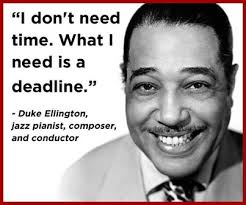
Photo of Duke Ellington with quotation about not needing time, needing a deadineThere is another rationale I find compelling for not overusing this accommodation and certainly for limiting the deadline extension when permitted.  Often students ask for this accommodation when they’ve already missed several deadlines.  The rule is that accommodations are not retroactive, period.  So, it won’t undo what has been done.  Furthermore, often allowing students who struggle with deadlines to begin with, the flexibility in putting them off even longer, only serves to dig them deeper into a hole with more piling up on top of them.  This in turn exacerbates stress and anxiety.

Remember the access vs. success distinction. When students request flexibility in deadlines, they are often really asking because permitting flexibility is needed for success, not access.  This is why these considerations are usually not appropriate as accommodations.  Add on the reasonableness test, and we see that it is a rare instance where this accommodation should be awarded.  This doesn’t mean that flexibility cannot be given (with limits), but that is typically more appropriately a discussion between student and professor (or class dean and professor) because it does not fall within the parameters of an accommodation.

We’ve focused on accommodations (access) quite a bit.  Next week, we’ll shift topics to ones involving success — what we can do to help students with disabilities.


Q & A:

Given what has been discussed this week and last, why do our faculty members see flexibility in attendance and/or deadlines as an accommodation (as often as they do) on the Accommodations Memo they receive from students?

The short answer is that our college’s policies and procedures regarding these two accommodations have recently been revised to be in line with best practices.  However, Student Accessibility Services will not revoke accommodations that have already been awarded to students prior to these updates.  Given the new policies and procedures, these two accommodations will not be issued with the same frequency as has been in the past.