
New Method for Notifying Faculty of Approved Accommodations

Text "you've got mail" with picture of open mailbox with letter inside

Welcome back!

In the spring, I’d written about Student Accessibility Services’ new online data management system, Accessible Information Management (AIM).   This is to remind you that one of the features of AIM is the email notification to faculty of approved accommodations.  Faculty will no longer be receiving a piece of paper (known as Faculty Accommodation Memo) from students with the listed accommodations.  Instead, faculty members will receive a Faculty Notification Letter sent to your email through AIM.

Everything else related to receiving accommodations remains the same:

  • Students MUST still request these Letters for each class, each semester. They should do this early on in the semester. If a student is approved for accommodations, however has not requested their Letter for your class, you should not be providing them with accommodations.
  • Students MUST still have a private meeting with each faculty member to whom they had a Letter sent in order to discuss the logistics of their accommodations. For example, you need coordinate how a student will receive 50% extended time on a test – arrive early, stay late, or take it at another time. These meetings should happen at the beginning of the semester.
  • Students who do not provide appropriate and timely notice to faculty as described above are not entitled to use their accommodations until they have met these requirements.

In order to not randomly bombard faculty with these email Faculty Notification Letters, they will be released through the AIM system on the first business day of the week following the student’s request for Letters.

The elimination of paper forms has made things much more efficient for students to request the use of their approved accommodations, and we hope that you find this new system easier for you as well!

Test Accommodations for Self-Scheduled Final Exams

Photo of exam Blue Book, test form, glasses, and penStudent Accessibility Services has made some changes to the notification process regarding use of test accommodations for self-scheduled final exams.  The intention is that these changes should make the process of arranging for test accommodations for finals more efficient.  An email was sent out to faculty yesterday that explains the changes described below.

By this time in the semester, students should have already given their professors their Faculty Accommodation Memo, which lists the student’s approved accommodations.  Testing accommodations can include extended time, reduced-distraction or private environment, use of College computer, and ability to use calculator.  It is a good idea to make an announcement in class this week that any students who have approved accommodations and wish to use those for their final exam, but who have not yet given you their Accommodation Memo, must do so within the next week.  This will allow sufficient time for students who still have not requested Memos from SAS to do so and get them submitted to you.

Last week, SAS emailed all students with approved test accommodations asking for which self-scheduled exams they intended to use their accommodations.  Students must inform SAS of this by April 26th.    One of the changes this semester is that students will do this via a Google Form, and they will no longer be bringing a piece of paper for their professor to attach to their exam.  Another change is that after the April 26th deadline, Lillian Liebenthal, Student Accessibility Coordinator, will email each professor with a list of students for each class who intend to use test accommodations.  Professors will place those exams on the top of the exam pile (for each class) they submit to the Registrar’s office (no need to attach a sheet of paper).

SAS will inform the Registrar’s office which students will be using test accommodations on their self-scheduled final exams.  Once the Registrar has all exams submitted to their office (deadline is Wednesday May 10 at 5pm), they can then send exams for which accommodations will be used to the Test Center at the Academic Resource Center.  This is the location where all self-scheduled final exams must be taken.  As has been done in the past, professors handle accommodations directly for scheduled final exams.

We hope that eliminating the extra step of students bringing a form for professors to attach to exams, which help to make the process simpler and more efficient.  Next week, I’ll be sharing some other news about improved efficiency in the office of Student Accessibility Services!


Twitter logo

Student Accessibility Services is now on Twitter!  Follow us for articles of interest related to disabilities, teaching, and learning.


The Accommodation of Access to Notes & How Faculty Can Make Notes More Accessible

pen resting on pad of paperA student with the accommodation of “access to notes” might have qualified for the accommodation due to a visual or hearing impairment, an attentional issue, a processing difficulty, or a struggle with working memory.  There are different ways of providing this access depending upon the individual’s functional limitations, therefore an Accommodation Memo might list “use of a recording device” or “access to a peer note taker.”  There are also variations that include “copy of teacher notes” or “copy of PowerPoint slides in advance.”

The reason for the note taking assistance is that something about the individual’s disability impacts his or her ability to create a set of notes that documents important information from class.  The level of impact varies, and the accommodation should be in line with the extent that the individual’s note-taking capacity is limited.  Student Accessibility Services is working toward customizing this, looking at each student’s ability to take notes and what he or she needs to be able to create notes at the same level as students without disabilities.

For example, many students with disabilities take notes in class, however due to a slower processing speed or attentional issues, may miss some information during the lecture or discussion.  For these students, the accommodation of “use of a recording device” is ideal because the recording allows the student to go back later and fill in the missing information.  There are technology devices – referred to as assistive technology – that can make this very easy and efficient for students.  Assistive technology refers to a device or program that allows those with disabilities to enhance their functionality and increase their independence.

Two pieces of assistive technology for note taking, which are available for students to borrow from the SAS office, are the Livescribe Smart Pen and Sonocent Audio Notetaker program.  The Smart Pen is used in conjunction with a special notebook that includes markings on it to start and stop the pen’s recording; there are also markings on the page that align the recording with where your written notes are on the page.  So, a student touches the spot on the page where she missed something in the notes, and she can listen back and fill in her notes.  Or, a student can just listen back to a part of the lecture that was unclear or challenging.

Sonocent Audio Notetaker works in a similar way, but is a computer program.  The lecture is recorded through the student’s laptop, and the student’s typed notes are aligned with the recording.  If something is missed in the notes – just click in that spot and that part of the lecture is replayed.  There are also tablet and smartphone apps that perform similar tasks.

For many students with disabilities, the use of assistive technology enables them to take their own notes, with the technology able to compensate for their functional limitations.  The benefit is that students are able to make a complete set of notes independently and do not have to rely upon another student’s judgment as to what was important enough to include in notes.  Also, another student may already know or understand something and therefore not include that in their notes.  Taking your own notes with technology assistance avoids these issues.

The accommodation of a peer note taker is intended for a student who cannot make a set of usable notes independently that can then be supplemented with the use of assistive technology.  The peer note taker is still intended to supplement the student’s own notes to the extent that the student can take his or her own notes independently.

There are some ways that faculty can proactively make class notes more accessible for all students (following principles of universal design for instruction).  One is by putting your own notes (or a skeletal outline for students to fill in) onto Moodle, so that all students in class can use those to compare to their own notes – students will fill in their own notes or rely on the teacher’s notes as needed.  students in classroom taking picture of boardThis can be especially helpful in classes with mathematical problems where it may be hard for students to accurately or quickly copy what the teacher is writing on the board, and a recording of such may not be very useful when the primary intake is visual.  A second is to have a dedicated class note taker (class members can take turns) who posts his or her notes on Moodle for the rest of the class to review and compare to their own notes.  A third is to record the class – audio or video – and post the recording on Moodle.  And finally, a simple method is to allow students to take a picture of the board with their phones if you’ve written a lot of information, drawn a diagram or chart, or solved a math problem that may be hard to recreate in their notes.

Faculty and staff members who are interested in learning more about assistive technology can contact Lillian Liebenthal at x5428.


Concerns About Recordings
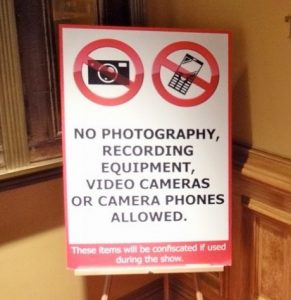
No photography, no recording signSome faculty members worry that recordings stifle class discussions or may be misused.  First and foremost, §504 of the Rehabilitation Act of 1973 doesn’t mention many specific accommodations, but it does explicitly state “use of tape recorder” as an example of providing access when necessary for an individual with a disability.  So, like it not, it’s one of the few things that the law explicitly includes.  Secondly, if there is a sensitive topic being discussed, students who are recording can be told to stop – as long as students taking written notes are told not to take notes at that time (remember, it’s about equal access, so if no students can take notes, then students with a note taking accommodation don’t get to either).  Thirdly, our Use of Recording Device policy and agreement address appropriate use of recordings – click on the links to read the limitations of the use of the recordings and consequences for misuse of recordings.

The Accommodation of Extended Time

hourglassSince this is the beginning of the semester and professors are receiving Accommodation Memos from students, I thought this would be a good time to share some information about what is probably the most common accommodation:  extended time on tests, quizzes, and in-class assignments.  It also can be perceived by some as an “unfair advantage,” and this will be addressed as well.

First, why is this accommodation given?  This accommodation is meant to provide an equal opportunity for students who, due to a disability, need this extra time to be able to demonstrate what they know or can do as opposed to the impact of their disability.  The need for this extended time is evaluated based upon what is known as the individual’s “functional limitations,” most commonly pertaining to things like reading, writing, concentrating, learning, thinking, and communicating.  For academic purposes, these functional limitations are measured through various tests, typically called a “neuropsychological evaluation” or “psychoeducational evaluation.”

These tests are comprehensive and look at several components of performance.  Cognitive functioning is measured; the Wechsler Adult Intelligence Scale, or WAIS, is the most common instrument used for individuals age 16 and older.  This test includes verbal comprehension, perceptual reasoning, working memory, and processing speed.  Verbal comprehension includes things like vocabulary, analogies, general knowledge, and comprehension.  Perceptual reasoning looks at visual-spatial and non-verbal problem solving, as well as quantitative reasoning.  Working memory is the amount of information one can hold in very short term memory while working with the information on some cognitive task.  Processing speed is how quickly information is taken in, one can make sense of it, and one can communicate information.  Other tests are also given that measure academic achievement on reading, math, and writing.  For some individuals, tests of executive functioning, such as planning and organization, and/or attention are given as well.

Extended time may be issued as an accommodation when the testing shows a substantial limitation to reading (fluency and/or comprehension), a limited working memory, a slow processing speed, or difficulty concentrating and focusing (this is not an exhaustive list, but the most common reasons).  As I said above, the extra time, often issued at 50% extra time, is meant to allow the student to compensate for the limitations due to a disability in order to demonstrate what they know or are capable of doing.  As a straightforward example, someone who has a very slow reading rate, would likely not finish a test that included a large amount of reading; the low grade that results does not accurately reflect knowledge or how well that student is capable of responding to the text, but rather would be due to the fact that he or she was not able to get through the entire test due to the reading disability.

What about fairness?  On the surface, it can sound unfair that someone has 50% more time to work on a test.   However, as far back as the early ‘90s, a study by Dr. M. Kay Runyan showed that students with learning disabilities benefited from extra time on tests, while non-LD students did not.  There have been several studies since that have duplicated the finding that students without a learning-related disability do not make statistically significant gains with extended time.  This is because, in the words of Nicole Ofiesh, Ph.D., who conducted some of these follow up studies, “No one will outperform their own potential . . . All the time in the world will not help someone answer a question if the answer if not known.  However, for those who know the answer and need more time to demonstrate what they know, extended time levels the playing field” (www.nicoleofiesh.com).


Spring Semester News and Reminders

updatesWelcome back!  Student Accessibility Services would like to let you know about some changes to our website.  Not only has the site been updated and redesigned for ease of navigability, we have also added a new section titled Faculty & Staff.  Here you will find a suggested syllabus statement regarding students with disabilities and accommodations.

There is also a helpful section on accommodations.  Included here is a listing of common accommodations, with a brief explanation of what each one entails as well as typical reasons the accommodation is issued.  This sub-section also includes the guidelines students are required to follow when utilizing the accommodation of Use of Recording Device as well as the agreement they sign acknowledging they understand and agree to the appropriate use of the recordings.

We include a reminder that should a faculty member feel that an accommodation compromises an essential element of his or her course or program, he or she should contact SAS as soon as possible to discuss the concerns.  Accommodations are not meant to compromise or lower course requirements or expectations.

Accommodation notification deadlines are included in this section as well.  While students may request accommodations from SAS at any time, registration with our office and the issuance of accommodations is a process that takes some time.  Students are encouraged to register with SAS as soon as practicable after their enrollment at the College and to request their Accommodation Memo for faculty at the start of each semester.  Faculty are entitled to reasonable notice (7 business days) of approved accommodations.  If a faculty member is provided with an Accommodation Memo with less notice, he or she is not required to provide the approved accommodation in this initial instance if it is not feasible to do so.  The accommodation would begin once the professor had appropriate notice and time to make any necessary arrangements.

Speaking of necessary arrangements, this segues well into a reminder to faculty that students should present you with an Accommodation Memo each and every semester they want to use their accommodations in your class.  The Memo should be given to you during a private meeting where you and the student can discuss exactly how you will provide the accommodation.  For example, if the accommodation is “50% extended time on tests, quizzes, and in-class assignments,” when will that 50% extra time occur?  Before class?  After class?  At a completely different time?  What space will be utilized if the classroom is not available for that time?  Problems arise when students hand a Memo to a professor and walk away without this discussion since the logistics are still up in the air.

Finally, we have added an Educational Resources section for faculty and staff.  It is still fairly small, but we are working on adding new resources.  As of right now, you will find a couple of videos (including “How Difficult Can This Be?” which I used during a Camp Teach & Learn workshop I presented on what it is like for students with learning disabilities in the classroom).  There is an article written by a retired university faculty member and disability in higher education expert titled “When Faculty Are TOO Accommodating.”  This discusses problems that this can cause for the college, faculty member, and student.  There is also a section with websites that may be useful to faculty and staff, including a link for The Center for Universal Design in Education.  If you have any suggestions for additional resources, please let us know!

We hope you find this new Faculty and Staff section to our website helpful!  We hope that you have been finding our blog beneficial as well — you can let any interested colleagues know that they can find a link to our blog in the new Faculty and Staff section as well.

The Accommodation of Flexibility in Assignment Deadlines

an exaggerated blown up face of a man pointing at a clockLast week we looked at flexibility in attendance.  This week, we’ll apply the same analysis to flexibility in assignment deadlines.
Again, we start with determining whether there is an access issue.  We often give extended time during tests due to the functional limitations of a disability.  Why not the same for longer assignments outside of class time?  The answer is that tests are given during a relatively short, fixed block of time where it is expected that non-disabled students will use that entire amount of time.  Hence in order to provide access, we accommodate students with disabilities through extended time.  Longer term assignments are not expected to be done during every minute of the student’s non-class time – students plan and manage their assignments in order to complete them on time and the expectation is that there is sufficient time for students, including students with disabilities, to get that work done by the deadline.  Again, could there be an access issue?  Sure, but the bar is high, so the finding of access issues regarding this request would be infrequent.

If it is determined there is an access issue, we also have a set of questions to determine the reasonableness of extending deadlines:

  • Do assignments regularly build on one another?  Is it necessary to complete one assignment in order to be able to begin the next, or are the assignments relatively discrete in nature?
  • Is class discussion of completed assignments a significant component of the classroom interaction? Would a student being present for such discussions and able to complete an assignment afterward put the student at an advantage over the students who completed the assignment on time?
  • Do completed assignments become part of the curriculum of the class (for example, the presentation of speeches in a speech class, or small group critiques of student work during class time)?
  • When assignments are given to be completed by the next class session, how much time do you estimate the typical student spends completing those assignments?
  • Are long-term assignment deadlines indicated on the class syllabus?

Based on a review of these questions, it is often unreasonable to provide an extension of deadlines as an accommodation because it is substantially compromising essential elements or standards of the course.  When it is reasonable, the reasonableness should add a day or so, not weeks.  A more appropriate accommodation for a student who consistently struggles meeting deadlines due to a disability would be a reduced course load because that does not compromise essential elements/standards of a course.

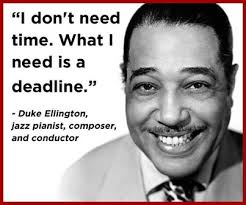
Photo of Duke Ellington with quotation about not needing time, needing a deadineThere is another rationale I find compelling for not overusing this accommodation and certainly for limiting the deadline extension when permitted.  Often students ask for this accommodation when they’ve already missed several deadlines.  The rule is that accommodations are not retroactive, period.  So, it won’t undo what has been done.  Furthermore, often allowing students who struggle with deadlines to begin with, the flexibility in putting them off even longer, only serves to dig them deeper into a hole with more piling up on top of them.  This in turn exacerbates stress and anxiety.

Remember the access vs. success distinction. When students request flexibility in deadlines, they are often really asking because permitting flexibility is needed for success, not access.  This is why these considerations are usually not appropriate as accommodations.  Add on the reasonableness test, and we see that it is a rare instance where this accommodation should be awarded.  This doesn’t mean that flexibility cannot be given (with limits), but that is typically more appropriately a discussion between student and professor (or class dean and professor) because it does not fall within the parameters of an accommodation.

We’ve focused on accommodations (access) quite a bit.  Next week, we’ll shift topics to ones involving success — what we can do to help students with disabilities.


Q & A:

Given what has been discussed this week and last, why do our faculty members see flexibility in attendance and/or deadlines as an accommodation (as often as they do) on the Accommodations Memo they receive from students?

The short answer is that our college’s policies and procedures regarding these two accommodations have recently been revised to be in line with best practices.  However, Student Accessibility Services will not revoke accommodations that have already been awarded to students prior to these updates.  Given the new policies and procedures, these two accommodations will not be issued with the same frequency as has been in the past.


The Accommodation of Flexibility in Attendance

man holding wine bottle labeled AbsenteLast week I described how we accommodate to provide for access, not success.  I also explained that even if there is an access issue, an accommodation must be “reasonable.”  We evaluate reasonableness through an “unreasonable” test (i.e., what isn’t unreasonable, is reasonable).  One prong of this test is that if an accommodation would substantially change an essential element of the student’s curriculum or academic standards, then it is unreasonable.

I realize there is too much to say about flexibility in attendance and deadlines for one post, so I will discuss attendance this week, and deadlines next week.  After that, we’ll be moving on to a topic other than accommodations for a change of pace.

Let’s look at the accommodation of flexibility in attendance in the context of what has been discussed so far regarding accommodations – whether there an access issue and whether it is reasonable.

What do other students have access to regarding attendance?  The opportunity to attend class and experience whatever it is that happens in that class.  The bar for assessing whether there is an access issue is whether the impact of the student’s disability makes it not possible to attend class. This is a high bar.  It is not whether it is difficult for the student to go to class.  If a student is hospitalized for a week due to his disability, we’ve clearly got an access issue.  If a student is in his or her dorm room and would prefer not to go to class because they aren’t feeling well, this isn’t, in the context of the law, an access issue.  We may feel bad for the student – as we would any student who doesn’t feel well.  That is usually why professors allow a limited number of absences without penalty.  Students with disabilities can use those as do all other students.

For the sake of argument, let’s say the determination is that there is an access issue.  We still need to look at the reasonableness of not being in class.  The Office of Civil Rights has given us a set of questions to consider regarding whether attendance is an essential element of a class:

  • Is there regular classroom interaction between the instructor and students and among the students themselves?
  • Do student contributions in class constitute a significant component of the learning process?
  • Does the fundamental nature of the course rely upon student participation as an essential method of learning?
  • To what degree does a student’s failure to attend class constitute a significant loss of the educational experience of other students in class?
  • What does the course description and syllabus say regarding attendance?
  • What is the method by which the final course grade is calculated?

In order to determine the answers to these questions, the disability services provider needs to have a discussion with each of the student’s professors.  Upon review of these questions, it’s pretty clear that for a student at a large university in a lecture class of 400, attendance may not be essential, however in a small liberal arts college such as ours, it is almost always an essential element of the class.  The question to the professor is then whether any additional absences beyond what they already allow would compromise the integrity of the course.  It may be that one or two additional absences are reasonable, or it might not.  This accommodation is not intended to permit a large number of absences.  A student who is not able to attend classes within the given parameters of “reasonableness,” may not be what is considered under the law to be “otherwise qualified” to attend school at this time.

The picture that is starting to come together here demonstrates that higher education disability law has limits.  As a college, we go above and beyond that in our efforts to support students and help them be successful.  That is why, even when an accommodation isn’t possible, a professor may be asked by a student or class dean to be more flexible.  Understand though, that is not a legal right.  It is your consideration.


When and why is an accommodation not appropriate?

Street sign with the word success on itLast week I wrote about why we issue accommodations to college students.  We provide “access” through accommodations when a student with a disability does not have the same opportunity as non-disabled students.  I listed a few examples of what providing access might look like.
Last week I also said that we don’t provide accommodations to college students in order to help them do well.  Of course we want our students to do well, however accommodations stop at access.  If an accommodation goes beyond access – beyond giving a student with a disability an opportunity that everyone else has – and enters the realm of permitting something because it will make the student successful, we’ve gone beyond the scope of the law.  Some people might call this “over accommodation” and others argue that once you’re doing things to make students successful, you are by definition no longer accommodating, period.  [See “More About Success” at bottom]

I just described the first reason issuing an accommodation is not appropriate: there is no access issue, but rather, we’re really talking about making a student more successful.  If we did do that, we in essence would have created an equity issue, an unfair advantage for students with disabilities.  That is not the intent of the disability laws – it’s supposed to be equal opportunity, not better opportunity.

dictionary definition of the word unreasonable

There is a second reason issuing an accommodation is not appropriate – when, even if an access issue exists, the proposed accommodation is “unreasonable.”  The law says we aren’t required to provide something “unreasonable” as an accommodation.  There are several prongs to the “unreasonable” test.  The one that is relevant from a faculty perspective is whether the proposed accommodation would fundamentally alter the nature of a program, compromise an essential element of a course or the curriculum, and/or weaken the academic standards or integrity of a course.  If the answer to any of these is yes, then you’ve got an over-accommodation, non-accommodation, bad accommodation – whatever you call it, disability services shouldn’t issue it (there may still be a reasonable alternative that we can issue as an accommodation).

Next week I want to further explore the issue of fundamental alterations and compromising essential elements of a course/curriculum.  And I will do that in the context of the controversial accommodations of flexibility in assignment deadlines and attendance.


More About Success:

Disability service providers can help students be successful.  We can discuss learning strategies, study strategies, time management, note taking, course selection, resources on campus, etc.  In fact, we try to make students with disabilities successful in the exact same ways we try to make all students successful, disability or not.  We just can’t do it through issuing an accommodation.

There are two related topics to mention here.  First, faculty can make adjustments to help students be successful all they want.  Faculty can make an alteration to the norm (for example, allowing more time for a student struggling to meet a deadline on a paper or needing more time to finish a test), for a student that they would make for any student in the same predicament regardless of disability status. What faculty members should not do is alter the norm for a student because he or she is a student with a disability, if they would not do that for a non-disabled student in the same situation.

The other related topic is that college students (and their parents) are almost always unaware of the access vs. success distinction.  In K-12 education, different disability laws apply (IDEA and a different sub-part of 504), and guess what those disability laws are all about?  Making students successful.  While students and parents have usually heard the vague message that “you might not get the same accommodations in college that you had in high school,” they don’t know what that really means or why things are different.  It’s about access vs. success.  This is all the more confusing because while the law puts a brick wall between access and success in higher education, the logical nexus still exists in students’ and parents’ minds – they’re thinking, “The whole reason I want my accommodations is so that I can do well in the class.”

Why do we issue accommodations to college students?


access key on keyboard

I thought I would start by posting over the next month or so about accommodations since that is something that many faculty members encounter frequently (though by no means am I implying that in working with students with disabilities, accommodations are the be all and end all).  I will do my best to break the topic into manageable chunks.  Feel free to comment and/or ask questions.

This week I’m addressing why we issue accommodations to college students.  The simple answer is anti-discrimination disability laws provide for it, when appropriate.  If you think we issue them because we want to help students do well, we don’t.  Come back next week for the explanation of that one!

Section 504 of the Rehabilitation Act of 1973 is a Civil Rights statute that forbids “denying access” to any program or activity provided by a college or university solely based on disability-status.  From this, we get the idea of providing students with disabilities “equal access” – the same access that students without disabilities have.  For our purposes, when we talk about most academic accommodations, we are talking about program access.  Architectural access is more straight forward (and covered by the Americans with Disabilities Act (ADA)) – if you’re in wheelchair, you can’t get into a building without curb cutouts and ramps; we’re talking about literal, physical access.

But, what do we mean by “access” in the classroom?  In this context, we mean equal access to opportunity.  The opportunity to participate fully in higher education and reap the same benefits as do others by participating in that activity.  Often, the way we allow for this opportunity is through an accommodation.

Accommodations are not issued simply by virtue of having a disability.  There must be an “access issue.”  There must be an opportunity the student with a disability does not have, and an accommodation will allow for that opportunity.  I keep talking about “opportunities,” so what does that mean?  Some examples will explain this best.  Oftentimes, an accommodation is meant to provide a student with the opportunity to demonstrate what they know, as in a test.  Non-disabled students have the opportunity to demonstrate what they know, whereas without an accommodation of extended time, a student with a disability would be demonstrating the impact of their disability rather than what they know.  Apply that same principle to the accommodation of a reduced distraction environment for testing.  In a note taking situation, typical students have the opportunity to take notes, whereas students with certain functional limitations due to a disability don’t have that same opportunity, so they are given an accommodation of the ability to record the class.

Next week, I’ll discuss when and why an accommodation is not appropriate.