Increasing Motivation to Learn: Establishing Value and Building Positive Expectancies

toddler trying to push a carLast week we looked at factors that influence students’ motivation to learn.  This week we’ll focus on two of those – motivation is increased when students perceive personal value in a learning goal and when they perceive a reasonable likelihood of being successful in achieving the goal.  Much of this is applicable in the classroom context, but some suggestions may be even more appropriate to utilize in interactions with students that take place outside the classroom.

Strategies to Establish Value

A significant step toward increasing a student’s perception of the value of a learning goal is to connect material to the student’s interests.  Allowing flexibility when possible for students to choose topics or projects helps them to see and feel (to connect with) the personal value in an assignment.  Another essential piece is to help show the student how this current goal is connected to their larger academic and professional goals.  What is the student’s major?  What do they want to do after school in their professional lives?  Even if they don’t know, how do the skills they will develop through an assignment or course connect more broadly to transferable professional skills?  Value in the small pieces can be increased when students see how they fit into their bigger vision.

This relates to another strategy to increase perception of value:  provide authentic, real-world tasks when possible.  This helps to connect abstract theory to something more tangible.  When students produce work to share with others, this is a move in this direction.  Depending on the class, this could mean assignments or projects that involve writing that will be published, posters that will be presented, pieces that will be performed, designed-objects that will be used by others, etc.

Finally, remember that an important way to establish value is to show students your own enthusiasm for the field of study you’re in and to explain what you value about it and why.

Strategies to Build Positive Expectancies

Students come to us carrying the experiences of their past.  Therefore, whether they feel they will be successful on an assignment or in our class, is the result of how they have performed in school throughout their education.  For some the past has provided confidence in their own abilities, and for others, it has created doubt.  What can we do now to help increase students’ expectation of success?

One way to help is to gauge what your students already know about something or can already do, and then see how this compares to your learning objectives for the class.  Do you need to provide more of a foundation than you expected?  Are you setting reasonable levels of challenge for them?  If students are not where they need to be, how will you scaffold them in order to help them get there?  Students will be motivated by achievable challenges – challenges that require effort, but are attainable.  Providing the right level of challenge at the right time is key as well. Starting off a course with smaller, low-stakes assignments can allow early opportunities for success, which can go a long way in building confidence and expectation of success as work becomes more challenging.

Making your expectations clear and providing assistance in how to meet those expectations is essential.  Explain to students what you expect them to do, how they can achieve those goals, what difficulties they might encounter, ways for them to overcome these difficulties, and what support you and others at the college offer.   Provide students with rubrics and frequent opportunities to get feedback from you.  Feedback should be timely so that students can use it on the next iteration of an assignment.  Point out strengths as well as areas that need improvement.  Make suggestions for how students can work toward improvement.  Explain to students not only what to study, but how to study to prepare for your tests or quizzes.

Equally, if not more, essential to creating an expectation of success in students is how you frame successes and failures in your interactions with them in and out of the classroom.  Also critical is teaching students how to reflect on their own learning for the purpose of improving it.  After spring break, we’ll look at a growth vs. fixed mindset and well as teaching students to learn with metacognition.  You can kick off this topic by attending the Talking Teaching workshop “Fostering Student Metacognition” tomorrow, Wednesday March 8 from 3-4:30pm in Hood!


Motivation to Learn

the word MotivationAll students are motivated.  As educators, we hope it’s to be deeply involved in the learning process . . . but that’s not always the case.  College students have competing interests that vie for their attention, time, and efforts.  They have more access to independence, lack of supervision, and choice than they probably ever had before.  Add in the constant presence of their peers and a range of opportunities for fun, and academics might not always make it to the top of the list.
Students who have struggled with learning – whether throughout their schooling or beginning later on as work became more challenging – may struggle with motivation regarding academics.  We think of college as a “choice,” however for some it does not feel that way, whether due to parental pressure or simply knowing that it takes a college degree to have many career options open to you.  Some love the idea of college, but the reality doesn’t live up to their fantasies.  Some just don’t feel ready for what they encounter academically and/or otherwise.  The difference between high school and college expectations is frequently cited by those with learning or attention-related disabilities as a major challenge for them in college.

Numerous theories offer explanations as to what impacts motivation.  Maslow’s hierarchy of needs helps explain why students who aren’t eating or sleeping well aren’t in the best condition to focus on learning.  Nor are students who feel like they are not in a place that is emotionally safe for them.  Nor are students who are preoccupied with friendships and relationships.  And, even for students who want to learn, their motivation to protect their image and the need to shield themselves from embarrassment could easily trump their willingness to take risks, which involves the potential for mistakes and failure.  To paraphrase Richard Lavoie, an educator who specializes in students with learning and attention issues:  adolescents would much rather be thought of as “bad or lazy” than “dumb.”

Another approach to looking at students’ motivation helps explain this.  A student will first look at the value they personally see in a goal – what will they get out of achieving this goal?  Is it intrinsically enjoyable, does it get them closer to a larger goal, does it get them a reward or praise, etc.? Motivation is increased when an individual finds personal value in the goal.  Then, they will look at the likelihood that they will be successful in achieving the goal.   Motivation is also impacted by their sense of self-efficacy, their perceived likelihood of success in achieving the goal.  This is where a student’s past greatly affects their current level of motivation.  A student with a history of struggling academically – or with certain types of academics (“I’m no good at math” or “I can’t learn a foreign language”) – is more likely to assume those struggles will continue.  They feel, “Why bother? It’s a waste of my time.”

Another critical factor that impacts motivation is the student’s perception of the supportiveness of the environment. Their perception, not ours.  He or she will consider the tone of the classroom or learning environment, the interpersonal dynamics with others (faculty, staff, fellow students), and the nature and structure of the communication – are others approachable or hostile, patient or impatient, judgmental or understanding, etc.?  Supportiveness of the environment doesn’t only mean what’s going on at the college, but also the family dynamics at play (I have seen college students make choices for the primary reason of sending a message to their parents).

When a student sees value in a learning goal, feels that there is a good likelihood of success in achieving it, and views the environment as supportive, that is when motivation to learn is most optimal.  Any negative perceptions regarding these factors, and the student can develop a sense of fragility, hopelessness, avoidance, or rejection; motivation toward the learning goal is reduced, sometimes greatly.

Next week we will look at some ways to help students perceive value in a learning goal and to increase their expectation of success for themselves.


Applying Principles of Universal Design in the Classroom

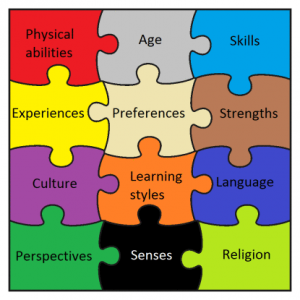
UD PuzzleAs stated in last week’s blog, Universal Design principles are intended to make a product, environment, or service accessible to all individuals – with a wide range of characteristics – by removing barriers proactively.  The barriers can be in architectural design, as was the first area where Universal Design was applied, but also in education.  The goal of Universal Design in education is to “…maximize the learning of students with a wide range of characteristics by applying UD principles to all aspects of instruction (e.g., delivery methods, physical spaces, information resources, technology, personal interactions, assessments).”[i]

The original Universal Design architectural principles, each followed by an example of how to apply these principles in education, are:

  1. Equitable use. The design is useful to people with diverse abilities. Example: A professor’s website is designed so that it is accessible to everyone, including students who are blind and use text-to-speech software.
  2. Flexibility in use. The design accommodates a wide range of individual preferences and abilities. Example: A museum, visited as a field trip for a course, allows each student to choose to read or listen to a description of the displays.
  3. Simple and intuitive use. Use of the design is easy to understand, regardless of the user’s experience, knowledge, language skills, or current concentration level. Example: Control buttons on science equipment are labeled with text and symbols that are simple and intuitive to understand.
  4. Perceptible information. The design communicates necessary information effectively to the user, regardless of ambient conditions or the user’s sensory abilities. Example: A video shown during class includes captions.
  5. Tolerance for error. The design minimizes hazards and the adverse consequences of accidental or unintended actions. Example: Educational software provides guidance and background information when the student makes an inappropriate response.
  6. Low physical effort. The design can be used efficiently, comfortably, and with a minimum of fatigue. Example: Doors to a lecture hall open automatically for people with a wide variety of physical characteristics.
  7. Size and space for approach and use. Appropriate size and space is provided for approach, reach, manipulation, and use regardless of the user’s body size, posture, or mobility. Example: A flexible science lab work area has adequate workspace for students who are left- or right-handed and for those who need to work from a standing or seated position.[ii]

Two additional principles added specifically regarding education are:

  1. A community of learners. The instructional environment promotes interaction and communication among students and between students and faculty.
  2. Instructional climate. Instruction is designed to be welcoming and inclusive. High expectations are espoused for all students.[iii]

Faculty can implement these principles in teaching strategies they use, the instructional materials they require or provide, classroom setup and facilities, and activities and field trips.  This is intended to benefit not just students with disabilities, but students with varying learning styles, language skills, backgrounds, interests, and levels of motivation, among other differences.


Some suggestions for faculty on applying Universal Design to their teaching:

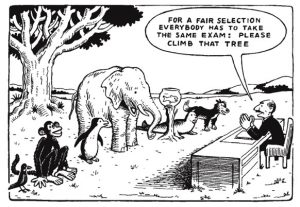
Cartoon showing variety of animals who must climb a tree as a test

  • Include a statement in your syllabus inviting students to talk with you and/or Student Accessibility Services about disability-related issues.
  • Point out campus resources available to all students such as the Academic Resource Center, Tutoring Center, Writing Center, and Counseling and Health Centers.
  • Clearly and early in a course, define course requirements, announce the dates of exams, and tell students when assignments are due. Avoid last-minute readings or additional assignments and provide advance notice of changes in assignments and due dates.
  • Provide printed materials early to allow students sufficient time to read and comprehend the material. Many students with learning disabilities use software that can read the textbook and other text-based materials aloud. In order for them to take advantage of this technology, the printed text must first be converted into an electronic file; this process can be time-consuming.
  • Use multi-modal methods to present classroom material in order to address a variety of learning styles and strengths (e.g., auditory, visual, kinesthetic). Provide important information in both oral and written formats.
  • When teaching a lesson, state objectives, review previous lessons, and summarize periodically. Repeat important information several times.
  • Use more than one way to demonstrate or explain information. Draw pictures, charts, or use other visual representations when possible.
  • Read aloud what you write on the board or present an overhead visual. Allow time to copy before erasing and/or allow students to take a picture with their phones.
  • Keep instructions brief and uncomplicated. Repeat them word-for-word.
  • Allow time for clarification of directions and essential information.
  • Use captioned videos and know how to turn on the captioning feature. Although captioned videos are typically used for students who are hearing impaired, they also help some students with learning disabilities and those for whom English is a second language by ensuring content is presented visually and audibly. Give all students an opportunity to view a video multiple times (e.g., by making it available in a library or on Moodle).
  • Provide study guides or review sheets.
  • Have multiple methods for assessment, such as allowing students to take an exam or write a paper; work alone or in a group; or deliver an oral, written, or videotaped project presentation.
  • Stress organization and ideas rather than mechanics when grading in-class writing assignments and assessments.[iv]

Endnotes:

[i] Sheryl Burgstahler, “Universal Design of Instruction (UDI):  Definition, Principles, Guidelines, and Examples,” DO-IT (Disabilities, Opportunities, Internetworking, and Technology) University of Washington, Accessed Feb. 16, 2017, http://www.washington.edu/doit/universal-design-instruction-udi-definition-principles-guidelines-and-examples .

[ii] Ibid.

[iii] “Nine Principles of UDI,” University of Connecticut Neag School of Education Center on Postsecondary Education and Disability/Center for Students with Disabilities, Accessed Feb. 19, 2017, http://udi.uconn.edu/index.php?q=node/12 .

[iv] Adapted from “Academic Accommodations for Students with Learning Disabilities,” DO-IT (Disabilities, Opportunities, Internetworking, and Technology) University of Washington, Accessed Feb. 19, 2017, http://www.washington.edu/doit/sites/default/files/atoms/files/Academic-Accommodations-Learning-Disabilities.pdf .

Looking to K-12 to Help Develop “Full Participation” in the Classroom

closeup of colorful crayon tips

There has been focus and discussion here at Conn regarding “full participation” in all aspects of the College, including in the classroom.  The working definition of full participation we are using is from Susan Sturm:

Full participation is an affirmative value focused on creating institutions that enable people, whatever their identity, background, or institutional position, to thrive, realize their capabilities, engage meaningfully in institutional life, and contribute to the flourishing of others.   http://wordpress.conncoll.edu/connections/full-participation/

Interestingly, this is very similar language used by educators who focus their work on teaching students with learning disabilities.

In fact, students today come to college very familiar with this notion of full participation because this concept has been applied in K-12 classrooms since before they were born.  Today’s K-12 teachers are expected to reach and teach all of their students, with most special education occurring in the classroom as well.  The range is huge – students with intellectual impairments, students with learning disabilities, students who are underprepared, English Language Learners, typical learners, gifted learners, etc.  The way that K-12 teachers do this is through what is called “differentiation.”   This essentially entails determining where a student is academically and then how to support each and every student – bringing those who need remediation up to speed and challenging and pushing those who are advanced beyond grade level, and everything in between.

DifferentiationDifferentiated instruction requires a teacher to vary his or her approach to each student by customizing content, teaching techniques, learning strategies, and assessment tools.  In order to do this, instructors need to identify the learning outcomes they want students to achieve, must understand how each student learns best, and then design differentiated instructional approaches and assessments.  If they’ve tried something that doesn’t work, they go through the process again to adjust and adapt the learning experience for the student.  Sounds like a lot of work?  It is (not to mention adding classroom management and developing social skills into the mix) . . . thank your K-12 teachers!

We can use some of these same approaches that have been applied during students’ K-12 years to teaching students in college.  A significant step in this direction that has gotten attention at Conn is in applying principles of universal design for learning (also referred to as universal design for instruction).  Universal design for learning is a framework based on the philosophy of inclusion – making learning accessible to all students, addressing diverse needs, interests, and abilities.  Universal design for learning provides for different methods for students to take in information and to demonstrate what they know.  The approach increases student motivation, which contributes significantly to improved learning.

Universal design originated in architectural design, making physical space accessible to all, both those with and without disabilities.  In the same vein, universal design applied to learning is meant to benefit all students, with and without disabilities.  In addition to this benefit for all, a particular benefit for students with disabilities is that it can greatly reduce their need to ask for accommodations when access is given to all from the outset.

Next week we will focus on some specific examples of applying universal design for instruction and learning in the classroom.


The Accommodation of Access to Notes & How Faculty Can Make Notes More Accessible

pen resting on pad of paperA student with the accommodation of “access to notes” might have qualified for the accommodation due to a visual or hearing impairment, an attentional issue, a processing difficulty, or a struggle with working memory.  There are different ways of providing this access depending upon the individual’s functional limitations, therefore an Accommodation Memo might list “use of a recording device” or “access to a peer note taker.”  There are also variations that include “copy of teacher notes” or “copy of PowerPoint slides in advance.”

The reason for the note taking assistance is that something about the individual’s disability impacts his or her ability to create a set of notes that documents important information from class.  The level of impact varies, and the accommodation should be in line with the extent that the individual’s note-taking capacity is limited.  Student Accessibility Services is working toward customizing this, looking at each student’s ability to take notes and what he or she needs to be able to create notes at the same level as students without disabilities.

For example, many students with disabilities take notes in class, however due to a slower processing speed or attentional issues, may miss some information during the lecture or discussion.  For these students, the accommodation of “use of a recording device” is ideal because the recording allows the student to go back later and fill in the missing information.  There are technology devices – referred to as assistive technology – that can make this very easy and efficient for students.  Assistive technology refers to a device or program that allows those with disabilities to enhance their functionality and increase their independence.

Two pieces of assistive technology for note taking, which are available for students to borrow from the SAS office, are the Livescribe Smart Pen and Sonocent Audio Notetaker program.  The Smart Pen is used in conjunction with a special notebook that includes markings on it to start and stop the pen’s recording; there are also markings on the page that align the recording with where your written notes are on the page.  So, a student touches the spot on the page where she missed something in the notes, and she can listen back and fill in her notes.  Or, a student can just listen back to a part of the lecture that was unclear or challenging.

Sonocent Audio Notetaker works in a similar way, but is a computer program.  The lecture is recorded through the student’s laptop, and the student’s typed notes are aligned with the recording.  If something is missed in the notes – just click in that spot and that part of the lecture is replayed.  There are also tablet and smartphone apps that perform similar tasks.

For many students with disabilities, the use of assistive technology enables them to take their own notes, with the technology able to compensate for their functional limitations.  The benefit is that students are able to make a complete set of notes independently and do not have to rely upon another student’s judgment as to what was important enough to include in notes.  Also, another student may already know or understand something and therefore not include that in their notes.  Taking your own notes with technology assistance avoids these issues.

The accommodation of a peer note taker is intended for a student who cannot make a set of usable notes independently that can then be supplemented with the use of assistive technology.  The peer note taker is still intended to supplement the student’s own notes to the extent that the student can take his or her own notes independently.

There are some ways that faculty can proactively make class notes more accessible for all students (following principles of universal design for instruction).  One is by putting your own notes (or a skeletal outline for students to fill in) onto Moodle, so that all students in class can use those to compare to their own notes – students will fill in their own notes or rely on the teacher’s notes as needed.  students in classroom taking picture of boardThis can be especially helpful in classes with mathematical problems where it may be hard for students to accurately or quickly copy what the teacher is writing on the board, and a recording of such may not be very useful when the primary intake is visual.  A second is to have a dedicated class note taker (class members can take turns) who posts his or her notes on Moodle for the rest of the class to review and compare to their own notes.  A third is to record the class – audio or video – and post the recording on Moodle.  And finally, a simple method is to allow students to take a picture of the board with their phones if you’ve written a lot of information, drawn a diagram or chart, or solved a math problem that may be hard to recreate in their notes.
Faculty and staff members who are interested in learning more about assistive technology can contact Lillian Liebenthal at x5428.


Concerns About Recordings

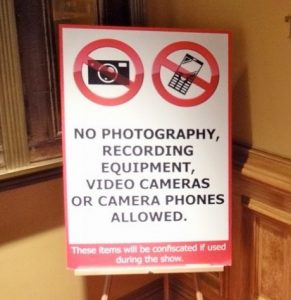
No photography, no recording signSome faculty members worry that recordings stifle class discussions or may be misused.  First and foremost, §504 of the Rehabilitation Act of 1973 doesn’t mention many specific accommodations, but it does explicitly state “use of tape recorder” as an example of providing access when necessary for an individual with a disability.  So, like it not, it’s one of the few things that the law explicitly includes.  Secondly, if there is a sensitive topic being discussed, students who are recording can be told to stop – as long as students taking written notes are told not to take notes at that time (remember, it’s about equal access, so if no students can take notes, then students with a note taking accommodation don’t get to either).  Thirdly, our Use of Recording Device policy and agreement address appropriate use of recordings – click on the links to read the limitations of the use of the recordings and consequences for misuse of recordings.

The Accommodation of Extended Time

hourglassSince this is the beginning of the semester and professors are receiving Accommodation Memos from students, I thought this would be a good time to share some information about what is probably the most common accommodation:  extended time on tests, quizzes, and in-class assignments.  It also can be perceived by some as an “unfair advantage,” and this will be addressed as well.

First, why is this accommodation given?  This accommodation is meant to provide an equal opportunity for students who, due to a disability, need this extra time to be able to demonstrate what they know or can do as opposed to the impact of their disability.  The need for this extended time is evaluated based upon what is known as the individual’s “functional limitations,” most commonly pertaining to things like reading, writing, concentrating, learning, thinking, and communicating.  For academic purposes, these functional limitations are measured through various tests, typically called a “neuropsychological evaluation” or “psychoeducational evaluation.”

These tests are comprehensive and look at several components of performance.  Cognitive functioning is measured; the Wechsler Adult Intelligence Scale, or WAIS, is the most common instrument used for individuals age 16 and older.  This test includes verbal comprehension, perceptual reasoning, working memory, and processing speed.  Verbal comprehension includes things like vocabulary, analogies, general knowledge, and comprehension.  Perceptual reasoning looks at visual-spatial and non-verbal problem solving, as well as quantitative reasoning.  Working memory is the amount of information one can hold in very short term memory while working with the information on some cognitive task.  Processing speed is how quickly information is taken in, one can make sense of it, and one can communicate information.  Other tests are also given that measure academic achievement on reading, math, and writing.  For some individuals, tests of executive functioning, such as planning and organization, and/or attention are given as well.

Extended time may be issued as an accommodation when the testing shows a substantial limitation to reading (fluency and/or comprehension), a limited working memory, a slow processing speed, or difficulty concentrating and focusing (this is not an exhaustive list, but the most common reasons).  As I said above, the extra time, often issued at 50% extra time, is meant to allow the student to compensate for the limitations due to a disability in order to demonstrate what they know or are capable of doing.  As a straightforward example, someone who has a very slow reading rate, would likely not finish a test that included a large amount of reading; the low grade that results does not accurately reflect knowledge or how well that student is capable of responding to the text, but rather would be due to the fact that he or she was not able to get through the entire test due to the reading disability.

What about fairness?  On the surface, it can sound unfair that someone has 50% more time to work on a test.   However, as far back as the early ‘90s, a study by Dr. M. Kay Runyan showed that students with learning disabilities benefited from extra time on tests, while non-LD students did not.  There have been several studies since that have duplicated the finding that students without a learning-related disability do not make statistically significant gains with extended time.  This is because, in the words of Nicole Ofiesh, Ph.D., who conducted some of these follow up studies, “No one will outperform their own potential . . . All the time in the world will not help someone answer a question if the answer if not known.  However, for those who know the answer and need more time to demonstrate what they know, extended time levels the playing field” (www.nicoleofiesh.com).


Spring Semester News and Reminders

updatesWelcome back!  Student Accessibility Services would like to let you know about some changes to our website.  Not only has the site been updated and redesigned for ease of navigability, we have also added a new section titled Faculty & Staff.  Here you will find a suggested syllabus statement regarding students with disabilities and accommodations.

There is also a helpful section on accommodations.  Included here is a listing of common accommodations, with a brief explanation of what each one entails as well as typical reasons the accommodation is issued.  This sub-section also includes the guidelines students are required to follow when utilizing the accommodation of Use of Recording Device as well as the agreement they sign acknowledging they understand and agree to the appropriate use of the recordings.

We include a reminder that should a faculty member feel that an accommodation compromises an essential element of his or her course or program, he or she should contact SAS as soon as possible to discuss the concerns.  Accommodations are not meant to compromise or lower course requirements or expectations.

Accommodation notification deadlines are included in this section as well.  While students may request accommodations from SAS at any time, registration with our office and the issuance of accommodations is a process that takes some time.  Students are encouraged to register with SAS as soon as practicable after their enrollment at the College and to request their Accommodation Memo for faculty at the start of each semester.  Faculty are entitled to reasonable notice (7 business days) of approved accommodations.  If a faculty member is provided with an Accommodation Memo with less notice, he or she is not required to provide the approved accommodation in this initial instance if it is not feasible to do so.  The accommodation would begin once the professor had appropriate notice and time to make any necessary arrangements.

Speaking of necessary arrangements, this segues well into a reminder to faculty that students should present you with an Accommodation Memo each and every semester they want to use their accommodations in your class.  The Memo should be given to you during a private meeting where you and the student can discuss exactly how you will provide the accommodation.  For example, if the accommodation is “50% extended time on tests, quizzes, and in-class assignments,” when will that 50% extra time occur?  Before class?  After class?  At a completely different time?  What space will be utilized if the classroom is not available for that time?  Problems arise when students hand a Memo to a professor and walk away without this discussion since the logistics are still up in the air.

Finally, we have added an Educational Resources section for faculty and staff.  It is still fairly small, but we are working on adding new resources.  As of right now, you will find a couple of videos (including “How Difficult Can This Be?” which I used during a Camp Teach & Learn workshop I presented on what it is like for students with learning disabilities in the classroom).  There is an article written by a retired university faculty member and disability in higher education expert titled “When Faculty Are TOO Accommodating.”  This discusses problems that this can cause for the college, faculty member, and student.  There is also a section with websites that may be useful to faculty and staff, including a link for The Center for Universal Design in Education.  If you have any suggestions for additional resources, please let us know!

We hope you find this new Faculty and Staff section to our website helpful!  We hope that you have been finding our blog beneficial as well — you can let any interested colleagues know that they can find a link to our blog in the new Faculty and Staff section as well.

Who Is Registered with SAS?

camels in the desertOver the past three weeks, I described some of the basic characteristics of Dyslexia, ADHD, and ASD, respectively.  This week, I thought I would share some information about some of the other disabilities students have registered with at Student Accessibility Services.

Currently, there are a little over 250 students registered with Student Accessibility Services.  There are three disability groups under which most of these students are classified:  learning disability (which includes Dyslexia), ADHD, and mental health conditions.   There is a good percentage of overlap, meaning many students fall into two and even three of these categories.  There are less than a dozen students at the College registered with Autism Spectrum Disorder.

Specific Learning Disorder

When it comes to learning disabilities, the largest number of our students have Dyslexia (more formally known as Specific Learning Disorder, Impairment in Reading, and also sometimes more informally referred to as a “language-based learning disability”).  There are two other types of Specific Learning Disorders.

Dyscalculia (Specific Learning Disorder, Impairment in Mathematics)

Dyscalculia is an impairment in making sense of numbers and math concepts.  This means that these students lack an intuitive understanding of how numbers work and how to compare two numbers.  Dyscalculia is not talked about as much as Dyslexia, however some researchers believe it is equally as common.

Dysgraphia (Specific Learning Disorder, Impairment in Written Expression)

Dysgraphia is an impairment in writing, which can range from writing legibly to struggling to get thoughts down on paper.  This can also be referred to as a “disorder of written expression.”  This disorder can have symptoms that include visual-spatial difficulties, fine motor difficulties, language processing issues, spelling/handwriting challenges, grammar and usage problems, and difficulty in organizing written language.  This disorder can often go hand-in-hand with Dyslexia.

Other Learning Disabilities

Nonverbal Learning Disability (NVLD)

NVLD is a learning disability that does not affect reading or written language, but affects understanding non-verbal communications, such as body language, tone of voice, and facial expressions.   These students have strong language skills but may have weakness in abstract thinking, distinguishing details from the big picture, and may be overly literal.  They can also struggle with social cues and making friends.

Auditory Processing Disorder (APD)

This is not the same thing as a hearing impairment.  Individuals with Auditory Processing Disorder have normal hearing, but there is a disconnect between what the ear hears and the brain processes.  Unlike ADHD or ASD where students can struggle to understand the meaning of what they hear, with APD it is the sounds that the student struggles to understand.  Background noise can make this even more difficult.  This disorder can affect acquiring reading and writing skills since learning letter sounds can be very difficult.  These students do much better when they have information presented to them in writing, not just orally.

Visual Processing Disorder (VPD)

This is not a sensory impairment in vision, but rather an impairment in how the brain processes visual information.  Difficulties can include figure-ground discrimination, visual-motor processing, visual memory, and visual-spatial issues.  Students might be overwhelmed by too much visual information presented at once, struggle to copy notes off the board, skip lines when reading, and have trouble recognizing when they’ve seen something before.  This condition can often overlap with Dyslexia, Dysgraphia, and Dyscalculia.

Chronic Health Impairments

Approximately 15% of students are registered with a chronic health condition (short term conditions – those lasting or estimated to last less than six months – do not qualify as a “disability”).  Most of our students who are registered with a chronic health condition are registered with allergies, asthma, and/or digestive disorders such as Crohn’s Disease or Irritable Bowel Syndrome.  There are also a few individuals with Lyme Disease and with arthritis.

Sensory Impairments

These include vision and hearing impairments.  At present, we do not have any students registered with us who are blind or deaf, but we do have individuals who have significantly impacted vision or hearing.

Mental Health Conditions

A large percentage of students are registered with SAS with a mental health condition, with Anxiety and Depression the most common.  We also see registration with Bipolar Disorder (formerly called Manic Depression), Obsessive-Compulsive Disorder, Panic Disorder, and Post-traumatic Stress Disorder (PTSD).   A discussion about the impact of mental health conditions on the college student will be saved for a later time as that is an in-depth topic.

I hope this provides a basic idea of the variety of disabilities that exist on our campus.  If you are interested in learning more about how learning disabilities impact students in the classroom, you can watch the full video, How Difficult Can This Be?  F.A.T. City, that was shown in my Camp Teach & Learn workshop “What Is It Like to Have a Learning Disability?” by clicking here. [Tip: Use Chrome as a browser to view].   While it is dated and geared toward K-12, it is by far the best resource I’ve found to help educators understand what it is like for the learning disabled student in the classroom.

This blog will continue at the beginning of the Spring semester!  Have a wonderful winter break!


What is ASD?

autism ribbon

Autism Spectrum Disorder (ASD) is a brain-based developmental disability that affects how information is processed; it specifically impacts communication and social interactions.  Until recently, the autism spectrum included several distinct diagnoses, however since 2013 under the DSM-5 (Diagnostic and Statistical Manual, 5th edition), all of these diagnoses are now included under Autism Spectrum Disorder.

Symptoms of ASD range in severity.  These symptoms can include difficulty with flexibility of thought and change in routine, obsessive interests, repetitive behaviors and routines, and sensory processing issues – both over-reactive and under-reactive.  Most students with ASD who attend college fall under the diagnosis formerly referred to as Asperger’s Syndrome.  You may still hear reference to Asperger’s since the DSM-5 specifically grandfathered this diagnosis for those who already had it.  I also use the term “Asperger’s” below to describe individuals with ASD.

Individuals with Asperger’s have average to above-average intelligence, even at the gifted level.  Asperger’s is technically not a learning or attention issue, however it can share a lot of similarities with both, and academic accommodations for all three are often similar.  One symptom those with Asperger’s can share with individuals with ADHD includes difficulty with executive functioning – including organization, problem solving, and control over emotions.   Also similar to those with ADHD, individuals with Asperger’s can be easily distracted by sensory input – sights, sounds, and smells.  As with peers with language-based learning disabilities, people with Asperger’s can struggle to express themselves clearly and to follow auditory information.  Similar to those with both ADHD and language-based learning disabilities, individuals with Asperger’s can also struggle with reading non-verbal cues, being overly literal, and not understanding jokes, puns, or idioms.

In the college setting, students with ASD can struggle both in and out of the classroom.  In the classroom, an ASD student might have sensory difficulties with sounds that others can tune out and fluorescent lighting.  They may also struggle with interacting with professors and classmates.  When it comes to academic work, he or she can struggle with setting goals, planning, prioritizing, pacing readings and long-term assignments, comprehension of abstract ideas and analysis, and seeing the big picture not just details.  Having a schedule that varies from day to day can also be difficult.  Dorm life can be very difficult for ASD students for a variety of reasons – needing assistance with some daily living skills, needing a quiet space to get away from sensory overload, and difficulty in getting along with a roommate as they may struggle with understanding the thoughts and intentions of others or realizing how they come across to others.

ASD often co-exists with other conditions.  An individual can have both ASD and ADHD.  Some studies have shown that as many as half of individuals with ASD also have ADHD.   Anxiety is also very common in individuals with ASD, perhaps occurring in as many as 85% of those with ASD.  Depression is also more common among those with ASD than in the general population.

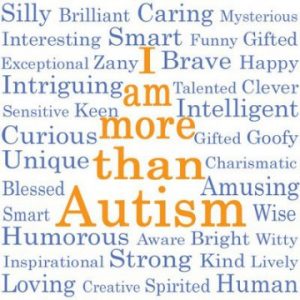
"I am more than autism"

Neurodiversity, a concept that began within the autism field, provides a paradigm shift in how we think about mental functioning.  Instead of looking at neurological differences as a deficit or dysfunction in mental processing, neurodiversity suggests we speak about differences in cognitive functioning (the same way we look at differences in biological or cultural diversity).  The belief is that atypical neurological development is a normal human difference that is to be respected as any other human variation.  Hardships are to be acknowledged, however we should also recognize an individual’s strengths.

Some of the strengths of those with Asperger’s include attention to detail, tendency to be logical, independent thinking, conscientiousness, and coming up with creative solutions.  Their strengths often align well with careers in computer programming, engineering, video game design, accounting, statistics, physics, and math.  Some famous people who have stated that they have Asperger’s include singer Susan Boyle, actress Daryl Hannah, actor Dan Aykroyd, and animal science professor Temple Grandin.  Historians believe that Albert Einstein, Mozart, Michelangelo, Thomas Jefferson, Emily Dickinson, Lewis Carroll, and Nikola Tesla are some of the many famous individuals throughout history who met the criteria for Asperger’s.

What Is ADHD?

Cartoon of Dennis the Menace

Attention-Deficit Hyperactivity Disorder (ADHD) is a range of difficulties in the self-management system of the brain.  This system is often referred to as the executive function system and includes sustained attention, task initiation, impulse inhibition, working memory, time management, prioritizing, planning, goal setting, organization, flexibility, regulation of emotions, and metacognition.  The primary location in the brain that controls these functions is the pre-frontal cortex, which is not fully developed until one’s mid-20s to around 30.  As slow as this area is to develop, it may develop even more slowly in an individual with ADHD.

As with learning disabilities, ADHD is a lifelong condition, though some difficulties – such as hyperactivity – may lessen between adolescence and adulthood.  There are strategies and treatments to reduce symptoms in individuals with ADHD.

There are three classifications of ADHD – Predominantly Hyperactive-Impulsive, Predominantly Inattentive (sometimes referred at as ADD), and a Combined presentation.  As many as 11% of individuals by the time they are 18 have been diagnosed with ADHD, and diagnosis is more common in boys than girls.

Symptoms of ADHD

Inattention

  • forgets things, seems confused, appears to be not listening
  • difficulty concentrating, jumps from one activity to another
  • gets bored easily with an activity unless it’s very enjoyable
  • struggles to get organized and to complete tasks
  • difficulty following directions and learning new things
  • doesn’t understand things that peers typically grasp

Impulsivity

  • impatient
  • blurts out and interrupts
  • overreacts in emotional situations
  • doesn’t understand the consequences of his/her actions

Hyperactivity

  • talks almost constantly
  • has trouble sitting still and moves a lot
  • can’t stay in one place for long
  • fidgets, picks up things and plays with them

Impact of ADHD

ADHD affects one’s self-control over his or her body and impulsive behaviors.  It also affects organization, planning and learning.  Due to this, students in school and adults in jobs can struggle with the following:  keeping track of things, breaking down assignments/tasks into steps, completing assignments/tasks, keeping track of their thoughts, understanding and following directions, applying knowledge from one area to another, staying focused without getting bored, and using metacognition.  Social skills can also be impacted.  Individuals with ADHD can often have a difficult time making and keeping friends due to difficulty following social cues, difficulty controlling emotions, saying inappropriate things, and constantly interrupting.

Benefits of ADHD

There are some benefits associated with ADHD.  One is the ability to hyper-focus on a particular area of strong interest.  Another advantage is that being easily distracted can have the benefit of noticing things that others do not.  Struggling to follow directions can result in those with ADHD being creative since they need to become good at problem solving.  Research has shown that those with ADHD are better at coming up with creative designs and new uses for objects.

Celebrities with ADHD

Musicians Justin Timberlake and Adam Levine; comedians Howie Mandel and Jim Carrey;  actors Michelle Rodriguez, Ryan Gosling, Emma Watson, Will Smith and Liv Tyler; athletes Michael Phelps, Terry Bradshaw, and Simone Biles;  political Consultant James Carville; chef Jamie Oliver; dancer Karina Smirnoff; reporter Lisa Ling; and businessman Bill Gates.