 We’re shifting from discussing accommodations to tips and strategies for helping students with learning disabilities in the classroom (in fact, they can benefit students without disabilities as well).
It is necessary to know the basic definition of a learning disability in order to understand why these strategies help. Learning disabilities are learning problems that are not primarily related to intellectual disability or emotional disturbance. These problems are caused by neurological differences in brain structure and function that affect a person’s ability to receive, store, process, retrieve or communicate information. It is often assumed that learning disability means below average IQ, however this is not the case – by definition, in order to have a learning disability one must have average to above average intelligence.
There are many types of learning disabilities (in the future we can get more specific), but for now we won’t distinguish since these recommendations can benefit all students whether they have what typically falls under Learning Disability (LD), Attention-Deficit/Hyperactivity Disorder (ADHD), or Autism Spectrum Disorder (ASD) (which now includes what was formerly called Asperger’s). It is important to realize that the comorbidity rate of having an anxiety disorder in addition to any of these above-mentioned disabilities is as high as 50%. Anxiety also impacts learning.
There are a few more things that are helpful to understand about students with learning disabilities. First, many students with learning disabilities suffer from low self-esteem and set low expectations for themselves with greater frequency than their non-LD peers. Second, the difference between high school and college expectations is often cited as a major challenge by LD students, so helping bridge this gap is important. Confusion and feeling overwhelmed can often result in escape behavior, which is why students who struggle often don’t seek help. This is compounded by the feeling of not wanting to be different from their peers, as well as by learned helplessness from having received too much support in the past. Finally, LD students need to be honest with themselves about the fact that they may need to work harder than their peers in order to do well.
It is important for faculty and staff to understand ways that we can support LD students because research tells us that LD students who successfully complete college overwhelmingly attribute having developed a significant relationship with someone in the disability services office or a faculty member as a significant key to their success. Research also stresses that the strength of the disability services office and level/quality of communication, coordination, and collaboration with the rest of campus is key to the success of LD students.
Next week we start with these strategies by discussing “Wait Time.”
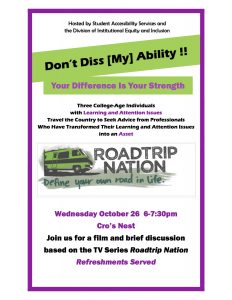
Upcoming Film Event ! ! !
Please consider attending — and please inform students — about this event.