 Difficulties associated with learning disabilities can include trouble distinguishing the big picture from supporting details, as well as understanding abstract concepts.
College classes often involve a significant amount of implicit instruction, where information or problems are presented to students to explore, assimilate, comprehend, and determine how it fits with existing knowledge on their own. Explicit instruction (or direct instruction), on the other hand, clearly outlines learning goals for students and directly explains skills or concepts, as well as how they relate to other skills or concepts.
For LD students, explicit instruction strategies can often be very beneficial, even at the college level. The instructor directly explains a skill or concept, then models that same skill/concept, often using a “think aloud” to demonstrate the method or thought processes involved. The instructor provides guided practice for the students, with immediate feedback to the student. Moving forward the instructor scaffolds the student’s practice less and less, building toward independence.
Here’s an example of this approach that I’ve used. I had my students read a chapter of a non-fiction book (Malcolm Gladwell’s Outliers) and then asked them the main idea of the chapter. A student answered that the majority of professional hockey players have birthdays in January, February, or March. The rest of the class agreed. I told them hockey players had nothing to do with the main idea of the chapter, that hockey players were a “pickle.” Yes, I got odd looks…but, they were intrigued.
I then asked the class what they would need if they wanted to make themselves an excellent burger. Some kind of patty, right? Beef, turkey, veggie, whatever, but without a patty, you just don’t have a burger. It is the main point of the burger. I took out my colored marker set and drew a brown patty on the whiteboard. I asked what else you need for a burger. Some kind of bread – bun, roll, focaccia, etc. It’s essential to support the patty otherwise you have a mess on your hands, literally. The bun represents the key points that are necessary to support your main idea. I drew a yellow bun around the patty. What makes the burger exciting to eat? All the stuff you put on the burger – mustard, ketchup, mayo, cheese, onions, lettuce, bacon, avocado, pickles . . . ! Those are the details of the burger that help make it delicious; they enhance the burger the same way an author uses interesting details to help support and explain the main idea. I used all the other colors to draw on a bunch of toppings. Since distinguishing the big picture from details can be a struggle for LD students, the drawing was a concrete representation of those abstract concepts.
Do hockey players as pickles make sense now? The story about the discovery that the majority of hockey players have birthdays in January, February, or March was a (deceptive) detail in the chapter. Deceptive because it sure takes up a lot of pages in the chapter. But, that doesn’t necessarily mean it is the main idea, and the students needed to be told that outright.
How did I then guide them to figure out the main idea? Explicit instruction in how to read the text. The chapter is divided into six sections – why? Does each section have a purpose or key point? I walked the class through certain key paragraphs. What is the significance of this word or phrase? Which sentence in this paragraph should jump out at you? How does this paragraph function in the context of the chapter? I didn’t give them the answers outright, but guided them through the types of things to look for when reading a non-fiction text.
I also used explicit instruction regarding the relationship of ideas – how the interesting details that they focused on support the key points, which in turn support the main idea. I supplemented that discussion with another visual representation – I drew an umbrella shape, writing the main point on the umbrella top in one color, with details in a different color contained underneath the umbrella to represent their relationship to each other. This type of visual cue can be very helpful for LD learners as it helps to ground their thinking.
Even if much of a class involves implicit instruction, incorporating explicit instruction at times can be beneficial to all students. It can be especially helpful to consider this approach in a one-on-one context with a struggling student.
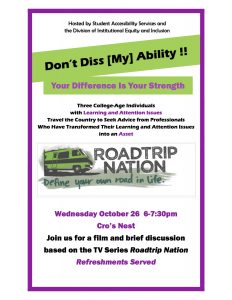
Reminder: Upcoming Film Event ! ! !